Trump bailing on the the Paris Agreement would be a middle finger to the future
By John D. Sutter
If the United States bails on the Paris Agreement on climate change, as CNN is reporting, the results could be catastrophic both for this country and the planet.
It would be a middle finger to the future.
The worst part: There is absolutely no reason for it. Aside, perhaps, from bravado and arrogance.
In walking away from the Paris Agreement, President Donald Trump would be turning his back on the entire world and on the consensus of climate science. Every nation except Syria, Nicaragua and now, potentially, the United States, is part of the accord, which calls for an end to the fossil fuel era -- and limiting global warming to at most 2 degrees Celsius above pre-industrial levels. (Nearly 200 countries or parties have adopted the agreement and 147, including the United States, at least for now, have ratified or approved it, indicating a stronger level of commitment, according to the UN Framework Convention on Climate Change).
I'm sure that target -- considered the "north star" of climate policy -- sounds
ridiculously abstract and wonky. But the 2 degrees goal is incredibly consequential. The fate of the planet -- and the mess we shove on future generations -- hangs in the balance.
Inaction on climate change will have disastrous consequences
Consider for a moment what is at stake with climate change: rising seas, flooded coastal cities, mass extinction, searing drought, human displacement, migration crises, deadlier heatwaves, crop failures, stronger storms.
This isn't some meaningless list plucked from an Al Gore PowerPoint. Our fingerprints are on many of these disasters now. As humans burn fossil fuels, chop down rainforests and pursue inefficient and polluting agricultural practices, we are causing heat-trapping gases like carbon dioxide to build up in the atmosphere. That acts like a blanket, gradually warming Earth.
Already, we've warmed the atmosphere about 1 degree Celsius in the fossil-fuel era.
The science on this is solid. US officials saying otherwise is negligent.
That's because warming has real consequences for real people. I've met them. In the Marshall Islands, I talked with people terrified their entire country, culture and language ("Iakwe" is the word for "hello," "I love you" and "You are a rainbow" in Marshallese) will be lost because of our indifference.
I spent a week with people in Madagascar whose livelihoods are dependent on coral reefs, which are struggling and may disappear or become utterly unrecognizable as we contribute to the rapid warming and acidification of the oceans. "We're as good as dead," a young mother told me. I met a man in Miami Beach, Florida, who was selling his homes because he fears his property will be regularly flooded. And a girl in Louisiana who had to be evacuated from her home during record rainstorms that scientists linked to global warming.
"It says to me and my community that they don't care what they do with the environment," Esau Sinnok, a college student from Shishmaref, Alaska, a community that voted in 2016 to relocate because of climate change, told me on Wednesday. "They don't care. They don't believe in climate change."
I've talked with biologists who say we are on the verge of Earth's sixth mass extinction event, with climate change being a major driver. Without massive changes, three-quarters of all known species could disappear in a couple centuries.
This stuff is just absolutely beyond nasty. It's abhorrent. And it's unthinkable to me that we could know these stories and still choose to do nothing. Because we know this:
The more pollution we create, the greater the risks. Smoking is an analogy many climate scientists use often, and for good reason. Can you keep smoking cigarettes for four more years and avoid dying from lung cancer. Maybe? But...
The rest of the world should move ahead without the United States
There's a terrifying math to climate change: We can only create so much pollution before we ensure the Earth will cross that dangerous 2-degree threshold, with consequences that are both immoral -- we can stop this if we want to -- and expensive.
Some estimates put that tipping point years or at most decades in the future.
Even with the full participation of the US, the Paris Agreement wasn't nearly enough -- on its own -- to avoid the very worst of global warming. Trump's withdrawal from the agreement would only up the odds of catastrophe -- and would do so considerably.
The exit would deliver a considerable blow to what needs to be a global agreement that includes the world's second biggest polluter. Greenhouse gases spread across the atmosphere. They don't adhere to national borders. So the process of fixing climate change, too, must be an international effort. Some will argue that the Paris Agreement will survive without Trump and without the US. I certainly hope that is true.
A recent report from Climate Action Tracker, a research group, finds China and India -- the other two of the top three global climate offenders -- are doing so much better than expected at cutting their emissions that the agreement can survive and meet its goals without US participation, at least temporarily.
The risk remains, however, that the Paris Agreement falls apart without the United States.
A China-US partnership on climate action is the main reason the world agreed to this accord.
Without the US as its partner, China -- with India and the EU -- could emerge as the global leader on climate. The agreement could succeed in spite of the United States. Or it could be weakened to the point of irrelevance.
Then, our best hopes for a livable, safe and clean future would start to fall apart, too.
Doing something about climate change is an 'America first' strategy
Again, the worst part of this: The US withdrawal is completely nonsensical.
Nearly seven in 10 American voters support the Paris Agreement, according to a November 2016 survey from the Yale Program on Climate Change Communication. So, there's little need for political cover.
And legal experts have said the Trump administration could remain part of the agreement without being held to the promises the Obama administration made to cut emissions and slow global warming. No, that's not ideal. But it's far and away preferable to a complete exit. Think of the Paris Agreement like a global party, former Obama climate negotiator Todd Stern told me recently. It's a party that gets way less interesting if one of the coolest and most important people just up and leaves -- with fanfare.
"All of a sudden it feels like, well, this isn't a very interesting party," Stern said in early May.
Plus, it's in America's interest to pursue a clean energy economy. There are more jobs in the United States right now in the solar industry than in coal mining. Yes, California and other states (Iowa got more than 35% of its electricity from wind power last year, amazingly) are moving ahead with or without Trump. But the federal policies -- both the signal they send and the emissions they control -- matter. They could point the United States toward a cleaner future or, as now seems apparent, back into the dirty fossil fuel era, with all the associated dangers.
The other gamble: The US risks getting left behind by China in the clean energy economy.
The best those of us who care about the Earth and its future can hope for is that Trump would change his mind. Officials have told reporters Trump will withdraw. But Trump is known for changing his mind at a moment's notice. On Wednesday, the President tweeted that he "will be announcing my decision on the Paris Accord over the next few days."
Other than that, the best case scenario is for China and the EU to take the lead on climate. For the US to be left behind. And for the rest of the world to spite Trump and the United States by picking up the slack for American pollution.
The worst case scenario? I almost don't want to go there.
May 31, 2017


Flee to Building Roof
Darrell Issa Appears to Flee to Building Roof to Avoid Protesters
Republican members of Congress are getting creative.
INAE OH
Rep. Darrell Issa (R-Calif.) was seen taking refuge on the roof of his office building in Vista, California, Tuesday, taking photos of angry constituents who had gathered below to protest the congressman's voting record. The incident comes before a much-anticipated town hall meeting this Saturday at San Juan Hills High School, where the nine-term congressman is expected to face a hostile crowd because of his support for various Trump administration policies, including the Republican plan to repeal and replace Obamacare.
Democrat Mike Levin, an environmental lawyer who recently announced his bid to challenge Issa in 2018, shared an image of the congressman appearing to avoid demonstrators on social media, where it was roundly mocked.
Twit:
"Yes, this is really @DarrellIssa on the roof of his district office building. Too afraid to come speak with assembled constituents below."
Others saw his retreating to a rooftop as reminiscent of Michael Scott, Steve Carrell's character in The Office who memorably took to the roof in the episode titled "Safety Training."
Twit:
"Sean Spicer: I hid in the bushes to avoid people! No one can top that!
Darrell Issa: Hold my beer. "
Twit:
"@MikeLevinCA @DarrellIssa You have to treat him like Michael Scott and tell him you have a present for him if he comes down."
Issa, on the other hand, described his trip to the roof a bit differently. Shortly after the criticism, he took to Twitter to offer this narrative. We recommend zooming in to take a closer look at the signs:
Twit:
"Spent the morning talking with constituents gathered outside the office today, then popped upstairs to take a quick pic!"
Republican members of Congress are getting creative.
INAE OH
Rep. Darrell Issa (R-Calif.) was seen taking refuge on the roof of his office building in Vista, California, Tuesday, taking photos of angry constituents who had gathered below to protest the congressman's voting record. The incident comes before a much-anticipated town hall meeting this Saturday at San Juan Hills High School, where the nine-term congressman is expected to face a hostile crowd because of his support for various Trump administration policies, including the Republican plan to repeal and replace Obamacare.
Democrat Mike Levin, an environmental lawyer who recently announced his bid to challenge Issa in 2018, shared an image of the congressman appearing to avoid demonstrators on social media, where it was roundly mocked.
Twit:
"Yes, this is really @DarrellIssa on the roof of his district office building. Too afraid to come speak with assembled constituents below."
Others saw his retreating to a rooftop as reminiscent of Michael Scott, Steve Carrell's character in The Office who memorably took to the roof in the episode titled "Safety Training."
Twit:
"Sean Spicer: I hid in the bushes to avoid people! No one can top that!
Darrell Issa: Hold my beer. "
Twit:
"@MikeLevinCA @DarrellIssa You have to treat him like Michael Scott and tell him you have a present for him if he comes down."
Issa, on the other hand, described his trip to the roof a bit differently. Shortly after the criticism, he took to Twitter to offer this narrative. We recommend zooming in to take a closer look at the signs:
Twit:
"Spent the morning talking with constituents gathered outside the office today, then popped upstairs to take a quick pic!"
Failing on everything... Here's one failure...
There is no boom in coal jobs
by Chris Isidore
There is no boom in coal jobs, despite what President Trump and his surrogates say.
Trump has been promising that his actions to lift environmental regulations on coal will bring back coal mining jobs.
"You're going back to work," Trump told a group of miners when he signed an executive order reversing limits on the use of coal in March. "Ready?"
"We will put our miners back to work," he promised. "We've already eliminated a devastating anti-coal regulation."
Vice President Mike Pence and Interior Secretary Ryan Zinke have also said that Trump's actions are bringing back coal jobs.
The most bullish jobs claim comes from Stephen Moore, an economic adviser to Trump during the campaign, who now works as a contributor for CNN. He has said repeatedly said that there have been 43,000 mining jobs added since Trump was elected president.
But that's not true.
While it is true is that the Labor Department figures show that 43,000 jobs have been added to "mining" jobs category since the final October jobs report just before the election, that category includes employment in oil and gas extraction, as well as traditional mining jobs.
At least 21,000 of the new positions were in the oil and gas industries, or related businesses. Another 6,000 more are in nonmetallic mining and quarrying, digging for things like granite and marble.
Only 1,300 jobs were added at coal mines.
When CNNMoney walked Moore through the Labor Department statistics, he said that even 1,300 new coal mining jobs is good news for the battered industry. But, he conceded, "That's a lot less than 43,000."
At the same time that Trump says he's trying to help coal, he's also signing orders that will boost the production of natural gas, which is cheaper than coal and poses the biggest threat to the industry and coal jobs.
Indeed, not everyone in the Trump administration is gung-ho about coal. President Trump's chief economist, Gary Cohen, has publicly questioned coal's future.
"Coal doesn't even make that much sense anymore," Cohen told reporters traveling with the president on his recent trip overseas. He added that natural gas is not only cheaper but it is cleaner.
But Moore said that the use of coal should increase in the future, if environmental regulations are eased.
"Coal mining has been highly affected by the price of natural gas. They're direct competitors," Moore said. "But it's also true the regulatory framework hurt coal. A reason to be optimistic about the future of coal is you no longer have a president who hates coal."
Moore says even with cheap natural gas, coal is poised for a comeback.
"The coal producers are getting a lot better in terms of mining techniques," he said to CNNMoney. "They're adapting to the new normal of very cheap natural gas."
But Moore also conceded that greater efficiency means mining more coal with fewer miners.
by Chris Isidore
There is no boom in coal jobs, despite what President Trump and his surrogates say.
Trump has been promising that his actions to lift environmental regulations on coal will bring back coal mining jobs.
"You're going back to work," Trump told a group of miners when he signed an executive order reversing limits on the use of coal in March. "Ready?"
"We will put our miners back to work," he promised. "We've already eliminated a devastating anti-coal regulation."
Vice President Mike Pence and Interior Secretary Ryan Zinke have also said that Trump's actions are bringing back coal jobs.
The most bullish jobs claim comes from Stephen Moore, an economic adviser to Trump during the campaign, who now works as a contributor for CNN. He has said repeatedly said that there have been 43,000 mining jobs added since Trump was elected president.
But that's not true.
While it is true is that the Labor Department figures show that 43,000 jobs have been added to "mining" jobs category since the final October jobs report just before the election, that category includes employment in oil and gas extraction, as well as traditional mining jobs.
At least 21,000 of the new positions were in the oil and gas industries, or related businesses. Another 6,000 more are in nonmetallic mining and quarrying, digging for things like granite and marble.
Only 1,300 jobs were added at coal mines.
When CNNMoney walked Moore through the Labor Department statistics, he said that even 1,300 new coal mining jobs is good news for the battered industry. But, he conceded, "That's a lot less than 43,000."
At the same time that Trump says he's trying to help coal, he's also signing orders that will boost the production of natural gas, which is cheaper than coal and poses the biggest threat to the industry and coal jobs.
Indeed, not everyone in the Trump administration is gung-ho about coal. President Trump's chief economist, Gary Cohen, has publicly questioned coal's future.
"Coal doesn't even make that much sense anymore," Cohen told reporters traveling with the president on his recent trip overseas. He added that natural gas is not only cheaper but it is cleaner.
But Moore said that the use of coal should increase in the future, if environmental regulations are eased.
"Coal mining has been highly affected by the price of natural gas. They're direct competitors," Moore said. "But it's also true the regulatory framework hurt coal. A reason to be optimistic about the future of coal is you no longer have a president who hates coal."
Moore says even with cheap natural gas, coal is poised for a comeback.
"The coal producers are getting a lot better in terms of mining techniques," he said to CNNMoney. "They're adapting to the new normal of very cheap natural gas."
But Moore also conceded that greater efficiency means mining more coal with fewer miners.
Climate Accord
The Paris Climate Accord Is Superficial. That's Why Trump Wants to Kill It.
KEVIN DRUM
The Paris climate accord is not legally binding. At any time, the United States can simply announce that its goals have changed and release a new, less ambitious plan to reduce greenhouse gas emissions (a "Nationally Determined Contribution" in Paris-speak). Since everything is entirely voluntary, and there's no legal enforcement mechanism for any of it, David Roberts says there's no reason to consider pulling out:
Trump can weaken the US NDC, without penalty. He can roll back all of Obama’s carbon regulations, without penalty. He can simply fail to meet the targets of the NDC, without penalty. All he has to do is explain himself at the five-year review, and the explanation can be as minimal as he likes.
Paris’s only constraint on Trump comes through intangibles like reputation and influence. It imposes absolutely no practical or legal constraint on his actions — not on trade policy, not on domestic energy policy, nothing.
That means all talk of Paris being a “bad deal” for the US, or hurting US trade, or affecting the US coal industry in any way, is nonsense. Paris does not and cannot do any of those things. The US voluntarily offered up an NDC and can voluntarily offer up a different or weaker NDC any time it wants.
This is an awkward fact for the nationalist contingent. They need Paris to be a boogey man. So they’ve ginned up a novel legal argument.
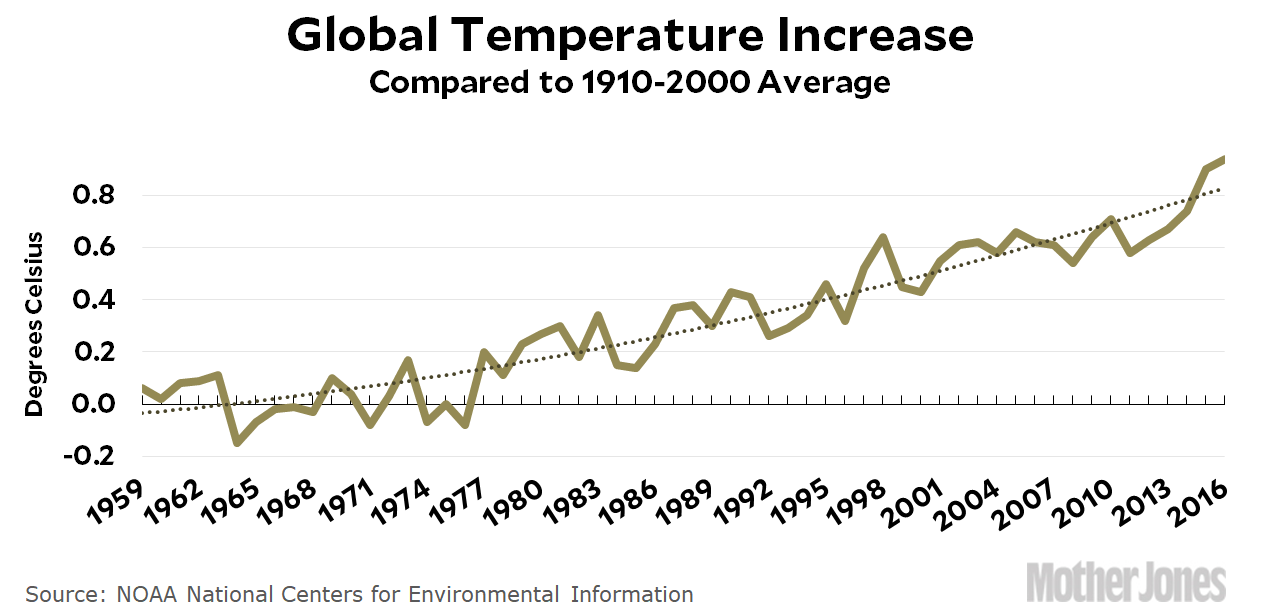
This novel legal argument is even more comical than these kinds of paper-thin justifications usually are, and you can read all about it at the link. But I think Roberts misses the point. Since Paris is voluntary, there's no concrete reason for Trump to pull out or to stay in. The United States can do whatever it wants either way. The whole thing is about signaling, and that's something that rules Trump's world. Barack Obama considered it important to signal that America was committed to addressing climate change. Donald Trump is committed to a worldview in which climate change is a hoax. He wants a dramatic way to signal this, and pulling out of Paris would be just the ticket.
Needless to say, you can decide for y


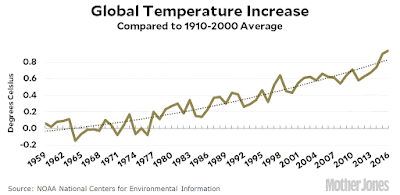 ourself if it's a hoax. The data is very clear and easily obtainable.
KEVIN DRUM
The Paris climate accord is not legally binding. At any time, the United States can simply announce that its goals have changed and release a new, less ambitious plan to reduce greenhouse gas emissions (a "Nationally Determined Contribution" in Paris-speak). Since everything is entirely voluntary, and there's no legal enforcement mechanism for any of it, David Roberts says there's no reason to consider pulling out:
Trump can weaken the US NDC, without penalty. He can roll back all of Obama’s carbon regulations, without penalty. He can simply fail to meet the targets of the NDC, without penalty. All he has to do is explain himself at the five-year review, and the explanation can be as minimal as he likes.
Paris’s only constraint on Trump comes through intangibles like reputation and influence. It imposes absolutely no practical or legal constraint on his actions — not on trade policy, not on domestic energy policy, nothing.
That means all talk of Paris being a “bad deal” for the US, or hurting US trade, or affecting the US coal industry in any way, is nonsense. Paris does not and cannot do any of those things. The US voluntarily offered up an NDC and can voluntarily offer up a different or weaker NDC any time it wants.
This is an awkward fact for the nationalist contingent. They need Paris to be a boogey man. So they’ve ginned up a novel legal argument.
This novel legal argument is even more comical than these kinds of paper-thin justifications usually are, and you can read all about it at the link. But I think Roberts misses the point. Since Paris is voluntary, there's no concrete reason for Trump to pull out or to stay in. The United States can do whatever it wants either way. The whole thing is about signaling, and that's something that rules Trump's world. Barack Obama considered it important to signal that America was committed to addressing climate change. Donald Trump is committed to a worldview in which climate change is a hoax. He wants a dramatic way to signal this, and pulling out of Paris would be just the ticket.
Needless to say, you can decide for y


Defend ...
Defend the EPA and NOAA’s Budget
Surfrider Foundation
The President's Budget for FY 2018 proposes steep and sweeping budget cuts for both the EPA and NOAA. If Congress does not push back against these debilitating cuts, neither agency will be able to effectively function past October 1rst at the start of the next fiscal year.
The EPA is tasked with protecting public health and the environment – clean air, water & land - and NOAA is responsible for conserving and managing our nation’s coastal and marine ecosystems and resources through science, service and stewardship. Critical programs that protect the health of swimmers at the beach and help coastal communities prepare for changing weather patterns and rising sea levels are at risk of being completely eliminated by the President’s budget proposal.
Clean water, healthy beaches and resilient coasts are important to those of us who live, work and play at the coast, and they are critical to the quality of life and economic vitality of coastal communities across the country. In fact, coastal recreation and tourism economies that rely on safe and healthy beaches are valued at over $100 billion and support 2.15 million jobs nationwide!
Please join us in asking Congress to reject the President’s budget proposal and to instead ensure at least level funding for both the EPA and NOAA in next year’s federal budget. Make your voice heard and send your email to Congress. Your beach, your health and even the jobs of millions of Americans could depend on it.
Surfrider Foundation
The President's Budget for FY 2018 proposes steep and sweeping budget cuts for both the EPA and NOAA. If Congress does not push back against these debilitating cuts, neither agency will be able to effectively function past October 1rst at the start of the next fiscal year.
The EPA is tasked with protecting public health and the environment – clean air, water & land - and NOAA is responsible for conserving and managing our nation’s coastal and marine ecosystems and resources through science, service and stewardship. Critical programs that protect the health of swimmers at the beach and help coastal communities prepare for changing weather patterns and rising sea levels are at risk of being completely eliminated by the President’s budget proposal.
Clean water, healthy beaches and resilient coasts are important to those of us who live, work and play at the coast, and they are critical to the quality of life and economic vitality of coastal communities across the country. In fact, coastal recreation and tourism economies that rely on safe and healthy beaches are valued at over $100 billion and support 2.15 million jobs nationwide!
Please join us in asking Congress to reject the President’s budget proposal and to instead ensure at least level funding for both the EPA and NOAA in next year’s federal budget. Make your voice heard and send your email to Congress. Your beach, your health and even the jobs of millions of Americans could depend on it.
The Problem...
Fox News Voters Are The Problem
By Bill Maher
America has been invaded by a culture that doesn’t share our values. But it’s not Muslims or Mexicans; it’s the Fox News voter. I’m guessing if you polled American Muslims or Hispanic immigrants they’d agree that health care is a right, that science means something, and that Presidents shouldn’t have family members soliciting business in Russia – but not the Fox News voter. Almost half the country now has values that aren’t what I think of as American values. I’m not talking conservative vs. liberal here, I’m talking about basic Bill of Rights stuff, and the notion of America as a country of disparate people united by a set of political beliefs.
The irony here is that the very people who are constantly complaining that American values are being lost are the ones who lost them.
I guess it’s because we’re the furthest thing from a homogeneous culture there is. We’re the “if it feels good, do it” country – which only works as long as we have an agreed up set of ground rules to keep a check on our rampant individualism. But now those ground rules are gone, and it’s not because of the hippies or rap music or Sharia law – it’s because Fox News (and the Internet) has made it okay to be a selfish dick.
By Bill Maher
America has been invaded by a culture that doesn’t share our values. But it’s not Muslims or Mexicans; it’s the Fox News voter. I’m guessing if you polled American Muslims or Hispanic immigrants they’d agree that health care is a right, that science means something, and that Presidents shouldn’t have family members soliciting business in Russia – but not the Fox News voter. Almost half the country now has values that aren’t what I think of as American values. I’m not talking conservative vs. liberal here, I’m talking about basic Bill of Rights stuff, and the notion of America as a country of disparate people united by a set of political beliefs.
The irony here is that the very people who are constantly complaining that American values are being lost are the ones who lost them.
I guess it’s because we’re the furthest thing from a homogeneous culture there is. We’re the “if it feels good, do it” country – which only works as long as we have an agreed up set of ground rules to keep a check on our rampant individualism. But now those ground rules are gone, and it’s not because of the hippies or rap music or Sharia law – it’s because Fox News (and the Internet) has made it okay to be a selfish dick.
Miseducation
The Miseducation of Betsy DeVos
By Ian Thompson & Jennifer Bellamy
Earlier this week, Education Secretary Betsy DeVos referred to opponents of vouchers as “flat Earthers” who have “chilled creativity” in the education system. While jarring, her comments will not come as a surprise to those who followed her confirmation. It was clear then, and remains so now, that Secretary DeVos is a dogged opponent of public education. She has dedicated years and a considerable fortune into working to attack public schools.
Secretary DeVos is entitled to her opinion, but not her own facts. Study after study has shown that voucher programs do not result in improved academic achievement. In fact, students who participate in the programs actually fare worse than their peers.
Voucher programs drain public schools of desperately needed resources and divert them to private and religious schools. Taxpayer dollars are then, often times, used to fund the religious education of students. In addition, students who attend private and religious schools through vouchers are deprived of critical civil rights protections that would otherwise be afforded to them in the public system, including students with disabilities.
In fact, students with disabilities are often systematically excluded from voucher programs. For example, a report from the U.S. Department of Education (the agency DeVos now heads) on the voucher program in Washington, D.C., found that the main reason why students didn’t use a voucher offered to them was that they were unable to find a participating school with appropriate services for their learning or physical disability or other special needs.
Despite all of this, the Trump administration budget proposal that was unveiled on Tuesday includes a request for a new $250 million dollar voucher program. This request comes at the same time as the administration is proposing jaw-dropping cuts in education funding.
Additionally, the Trump/DeVos budget proposal includes $1 billion in “portable” grant funding under Title I, meaning that the money follows individual children rather than being dedicated to high-poverty districts and schools. This allows states to redirect funds away from low-income schools towards schools with a large percentage of wealthier students.
The law says that separate but equal is never equal and recognizes the need to ensure state compliance with federal civil rights laws and to create equal opportunity for low-income students. There is an essential role for the federal government to play in working to eliminate discriminatory barriers, including the discrimination, segregation, and criminalization of students of color at schools. Adding insult to significant injury, Secretary DeVos either fails to recognize this need or is indifferent to it. Neither option is acceptable.
While there has been very little “swamp draining” since the start of the Trump administration, this budget proposal and similar efforts coming from the Department of Education make clear that the intention of Secretary DeVos is to drain as many resources as possible away from our public schools and the students who need them the most.
By Ian Thompson & Jennifer Bellamy
Earlier this week, Education Secretary Betsy DeVos referred to opponents of vouchers as “flat Earthers” who have “chilled creativity” in the education system. While jarring, her comments will not come as a surprise to those who followed her confirmation. It was clear then, and remains so now, that Secretary DeVos is a dogged opponent of public education. She has dedicated years and a considerable fortune into working to attack public schools.
Secretary DeVos is entitled to her opinion, but not her own facts. Study after study has shown that voucher programs do not result in improved academic achievement. In fact, students who participate in the programs actually fare worse than their peers.
Voucher programs drain public schools of desperately needed resources and divert them to private and religious schools. Taxpayer dollars are then, often times, used to fund the religious education of students. In addition, students who attend private and religious schools through vouchers are deprived of critical civil rights protections that would otherwise be afforded to them in the public system, including students with disabilities.
In fact, students with disabilities are often systematically excluded from voucher programs. For example, a report from the U.S. Department of Education (the agency DeVos now heads) on the voucher program in Washington, D.C., found that the main reason why students didn’t use a voucher offered to them was that they were unable to find a participating school with appropriate services for their learning or physical disability or other special needs.
Despite all of this, the Trump administration budget proposal that was unveiled on Tuesday includes a request for a new $250 million dollar voucher program. This request comes at the same time as the administration is proposing jaw-dropping cuts in education funding.
Additionally, the Trump/DeVos budget proposal includes $1 billion in “portable” grant funding under Title I, meaning that the money follows individual children rather than being dedicated to high-poverty districts and schools. This allows states to redirect funds away from low-income schools towards schools with a large percentage of wealthier students.
The law says that separate but equal is never equal and recognizes the need to ensure state compliance with federal civil rights laws and to create equal opportunity for low-income students. There is an essential role for the federal government to play in working to eliminate discriminatory barriers, including the discrimination, segregation, and criminalization of students of color at schools. Adding insult to significant injury, Secretary DeVos either fails to recognize this need or is indifferent to it. Neither option is acceptable.
While there has been very little “swamp draining” since the start of the Trump administration, this budget proposal and similar efforts coming from the Department of Education make clear that the intention of Secretary DeVos is to drain as many resources as possible away from our public schools and the students who need them the most.
Hold Ditsy's feet to the fire...
Warren: It's time to hold DeVos accountable
By Elizabeth Warren
Betsy DeVos recently completed her 100th day as Secretary of Education, and the resistance to her agenda has spread across this country like wildfire.
Last week, Secretary DeVos and President Trump's Department of Education released a budget that would upend the student aid program and make it much harder for students to afford college and repay their student loans. At the same time, the head of the federal student aid office abruptly resigned amid reports of political meddling by DeVos.
With the educational and financial futures of millions of people hanging in the balance, here's a place to start scrutinizing Secretary DeVos.
Early in the Obama administration, Congress gave full ownership of the federal student loan portfolio to the Department of Education, removing middlemen from the program and cutting out the profits that private banks skimmed off the system. This was a brave move that required standing up to some very powerful banks and private businesses that wanted to keep on skimming.
But now, years after the transition, the Department of Education often seems to ignore the original intent of this change and instead administers the trillion-dollar loan program for the financial benefit of nearly everyone except the students it is supposed to serve.
To the irritation of many in my own party, I regularly challenged the Democrat-led Department of Education to clean up its act on student loans. I pushed federal officials to tighten the spigot of federal funds that let fraudulent schools suck down billions in taxpayer dollars. I also fought to persuade the Department to cancel the loans of defrauded students, including thousands in Massachusetts. We made real progress.
When the Department failed to hold giant student loan servicer Navient accountable after the company was fined nearly $100 million by other federal law enforcement agencies for allegedly overcharging thousands of active-duty military personnel, I called them out and helped trigger an independent investigation. Those efforts ultimately helped push the secretary of education to begin refunding money to over 80,000 military borrowers and to commit to a complete overhaul of the federal contracts with student loan servicers. More progress.
These stories show that oversight matters -- and, with DeVos as secretary of education, oversight now matters even more. During her confirmation hearing, Secretary DeVos made it clear that she knew very little about running the federal student aid program. In her first weeks, she assembled a team that highlighted her plans to actively undermine efforts to protect students from being cheated.
Two of Secretary DeVos' first hires at the Department were Robert Eitel and Taylor Hansen, both with deep connections to institutions that make big money by abusing the student aid program and preying on students. Eitel was a top lawyer from a for-profit college that recently paid a more than $30 million fine to the Consumer Financial Protection Bureau for allegedly "deceiving students into taking out private student loans that cost more than advertised;" that for-profit college is currently under both state and federal investigation for breaking laws meant to protect students. Meanwhile, Hansen had been a top lobbyist for the entire for-profit college industry, which has paid out hundreds of millions in fines for defrauding students.
The revolving door that shuttles people between government jobs and the corporations they police is corrosive -- but it is rarely this brazen. One of Secretary DeVos' first actions on higher education was to delay a critical rule preventing fly-by-night colleges from loading students up with gigantic debts for worthless degrees, a move that directly benefited those same colleges that have paid Eitel and Hansen for years.
It also notably benefits these for-profit colleges that have been fined and have settled before, including Education Management Corp. (EDMC), which paid out $95.5 million after allegations of illegal recruitment and consumer fraud in 2015. At the time of the settlement, EDMC was a member of the Association of Private Sector Colleges and Universities, which Hansen represented.
Next, DeVos reversed a policy preventing student loan debt collectors from charging sky-high fees to students desperately trying to catch up on their student loans -- a policy whose loudest opponent was a major student loan debt collector that was headed by Hansen's father.
As news stories exposed these relationships, I wrote to Secretary DeVos, citing Hansen's and Eitel's conflicts and the Department's recent actions, asking for information about their roles. The day my letter arrived, Hansen resigned.
Oversight still works, but we've only just started. Eitel is still at the Department -- now as senior counselor to the secretary. Secretary DeVos' destructive policies on debt collection remain in place. And she recently ripped up critical reform policies that protect student loan borrowers from loan servicing companies like Navient that have demonstrated over and over their lack of concern for students. Notably, industry stocks have risen pretty much every time she has touched federal student loan policy -- including her recent announcement letting servicing companies off the hook from requirements that they affirmatively reach out and try to help struggling borrowers.
Now that DeVos is responsible for appointing the next head of the trillion dollar federal student aid office, we should all be very concerned that she may pick another person who also prioritizes the student loan industry and predatory colleges above students.
That's why today I am announcing a new project to hold Secretary DeVos' Department of Education accountable. DeVos Watch will seek information about the Department's actions and inactions around federal student loans and grants and highlight the findings. People can also participate directly by tracking the Department's actions, submitting oversight suggestions or filing whistleblower tips.
Where there are reasonable answers to the issues raised, the public will benefit from hearing them. Where there are no reasonable answers, the public will see that as well. And where Secretary DeVos and her agency refuse to answer, additional tools are available to get to the truth, including Freedom of Information Act requests, public interest litigation by student advocates and state law enforcement officials and investigations by the Department's nonpartisan Inspector General. Oversight will be a joint effort.
Accountability is about making government work for everyone. Regardless of political party, I'm hopeful that other policymakers will join me in efforts to hold the Department of Education accountable for serving our students -- not the industries that make money off them. We all have an interest in a well-run, fiscally responsible, corruption-free student aid program that puts students first. That is Secretary DeVos' job -- and it is Congress' job to make sure she does it.
By Elizabeth Warren
Betsy DeVos recently completed her 100th day as Secretary of Education, and the resistance to her agenda has spread across this country like wildfire.
Last week, Secretary DeVos and President Trump's Department of Education released a budget that would upend the student aid program and make it much harder for students to afford college and repay their student loans. At the same time, the head of the federal student aid office abruptly resigned amid reports of political meddling by DeVos.
With the educational and financial futures of millions of people hanging in the balance, here's a place to start scrutinizing Secretary DeVos.
Early in the Obama administration, Congress gave full ownership of the federal student loan portfolio to the Department of Education, removing middlemen from the program and cutting out the profits that private banks skimmed off the system. This was a brave move that required standing up to some very powerful banks and private businesses that wanted to keep on skimming.
But now, years after the transition, the Department of Education often seems to ignore the original intent of this change and instead administers the trillion-dollar loan program for the financial benefit of nearly everyone except the students it is supposed to serve.
To the irritation of many in my own party, I regularly challenged the Democrat-led Department of Education to clean up its act on student loans. I pushed federal officials to tighten the spigot of federal funds that let fraudulent schools suck down billions in taxpayer dollars. I also fought to persuade the Department to cancel the loans of defrauded students, including thousands in Massachusetts. We made real progress.
When the Department failed to hold giant student loan servicer Navient accountable after the company was fined nearly $100 million by other federal law enforcement agencies for allegedly overcharging thousands of active-duty military personnel, I called them out and helped trigger an independent investigation. Those efforts ultimately helped push the secretary of education to begin refunding money to over 80,000 military borrowers and to commit to a complete overhaul of the federal contracts with student loan servicers. More progress.
These stories show that oversight matters -- and, with DeVos as secretary of education, oversight now matters even more. During her confirmation hearing, Secretary DeVos made it clear that she knew very little about running the federal student aid program. In her first weeks, she assembled a team that highlighted her plans to actively undermine efforts to protect students from being cheated.
Two of Secretary DeVos' first hires at the Department were Robert Eitel and Taylor Hansen, both with deep connections to institutions that make big money by abusing the student aid program and preying on students. Eitel was a top lawyer from a for-profit college that recently paid a more than $30 million fine to the Consumer Financial Protection Bureau for allegedly "deceiving students into taking out private student loans that cost more than advertised;" that for-profit college is currently under both state and federal investigation for breaking laws meant to protect students. Meanwhile, Hansen had been a top lobbyist for the entire for-profit college industry, which has paid out hundreds of millions in fines for defrauding students.
The revolving door that shuttles people between government jobs and the corporations they police is corrosive -- but it is rarely this brazen. One of Secretary DeVos' first actions on higher education was to delay a critical rule preventing fly-by-night colleges from loading students up with gigantic debts for worthless degrees, a move that directly benefited those same colleges that have paid Eitel and Hansen for years.
It also notably benefits these for-profit colleges that have been fined and have settled before, including Education Management Corp. (EDMC), which paid out $95.5 million after allegations of illegal recruitment and consumer fraud in 2015. At the time of the settlement, EDMC was a member of the Association of Private Sector Colleges and Universities, which Hansen represented.
Next, DeVos reversed a policy preventing student loan debt collectors from charging sky-high fees to students desperately trying to catch up on their student loans -- a policy whose loudest opponent was a major student loan debt collector that was headed by Hansen's father.
As news stories exposed these relationships, I wrote to Secretary DeVos, citing Hansen's and Eitel's conflicts and the Department's recent actions, asking for information about their roles. The day my letter arrived, Hansen resigned.
Oversight still works, but we've only just started. Eitel is still at the Department -- now as senior counselor to the secretary. Secretary DeVos' destructive policies on debt collection remain in place. And she recently ripped up critical reform policies that protect student loan borrowers from loan servicing companies like Navient that have demonstrated over and over their lack of concern for students. Notably, industry stocks have risen pretty much every time she has touched federal student loan policy -- including her recent announcement letting servicing companies off the hook from requirements that they affirmatively reach out and try to help struggling borrowers.
Now that DeVos is responsible for appointing the next head of the trillion dollar federal student aid office, we should all be very concerned that she may pick another person who also prioritizes the student loan industry and predatory colleges above students.
That's why today I am announcing a new project to hold Secretary DeVos' Department of Education accountable. DeVos Watch will seek information about the Department's actions and inactions around federal student loans and grants and highlight the findings. People can also participate directly by tracking the Department's actions, submitting oversight suggestions or filing whistleblower tips.
Where there are reasonable answers to the issues raised, the public will benefit from hearing them. Where there are no reasonable answers, the public will see that as well. And where Secretary DeVos and her agency refuse to answer, additional tools are available to get to the truth, including Freedom of Information Act requests, public interest litigation by student advocates and state law enforcement officials and investigations by the Department's nonpartisan Inspector General. Oversight will be a joint effort.
Accountability is about making government work for everyone. Regardless of political party, I'm hopeful that other policymakers will join me in efforts to hold the Department of Education accountable for serving our students -- not the industries that make money off them. We all have an interest in a well-run, fiscally responsible, corruption-free student aid program that puts students first. That is Secretary DeVos' job -- and it is Congress' job to make sure she does it.
Nightmare
Awakening from the Trump Nightmare
In post-modern democracies, there is one and only one boss: public opinion. And the signs of public disgust are mounting.
BY BERNARD-HENRI LÉVY
The American people can escape from the ordeal of Donald Trump’s presidency in one of three ways. But if and when they do is an irreducibly political question, not one that hinges on legal possibilities.
First, there’s the Nixonian method, in which the president, worn down by the fight, simply resigns, scared and unwilling to submit to the proceedings that he sees mounting around him. But could that really be the exit taken by Trump? Does he share with his distant Republican predecessor a strong enough predisposition to melancholy? Can one picture a childish man, compulsive and narcissistic, surrendering without a fight the larger-than-life toy that is the top job in the most powerful country on the planet? I doubt it.
Second, there is Article 4 of the 25th Amendment to the Constitution, ratified in 1967, which spells out a process by which the vice president and Cabinet can act to replace a president who has died or is prevented by reasons of health from governing. Such might have been the case, four years earlier, following the assassination of John F. Kennedy, had Kennedy not died from his wounds. The possibility briefly resurfaced when President Ronald Reagan began to show the first signs of Alzheimer’s disease.
But the current situation does not resemble those cases. Trump may be unstable and unfit to govern, as his detractors claim. But is he any more so now than he was when the American people elected him? Probably not.
Finally, there remains the remedy of impeachment, which is being discussed more and more openly in Washington these days, accompanied (in a sign of the times) by a book, The Case for Impeachment, by Allan J. Lichtman. (A political historian, Lichtman is famous for having devised a model that has enabled him to predict the election of every American president from Ronald Reagan to Donald Trump.)
Impeachment, set out in Article 2 of the Constitution, is a procedure for the removal from office of a president, vice president or other top executive official (or judge) suspected of “treason, bribery or other high crimes and misdemeanors.” It is a complex process that unfolds in two phases: first, the House of Representatives must decide, by a simple majority, that the charges are serious enough to be tried; second, a full-fledged trial is conducted in the Senate, which must reach a two-thirds majority to convict the official and trigger immediate removal from office.
There are two main reasons to doubt that impeachment would rid the world of Trump. First, there is the balance of power in the Senate. At least 19 Republican senators would have to join the Democrats to convict Trump. At the moment, at most five can be counted on to do so. The only two presidential precedents (Andrew Johnson, impeached in 1868 for abuse of power, and Bill Clinton, impeached in 1998 for perjury and obstruction of justice) are hardly encouraging: both ended in acquittal by the Senate.
Second, there is the reluctance of Democratic Party bosses to see ultraconservative Vice President Mike Pence assume the place vacated by a fallen Trump. Wouldn’t he enjoy the same state of grace enjoyed by recent vice presidents who entered the Oval Office under exceptional circumstances (Lyndon Johnson after Kennedy; Gerald Ford after Nixon)? And what if he remained in office, not only for the remainder of Trump’s term, but for two four-year terms of his own?
All of this is logical enough. But times have changed since Johnson, Ford and even Clinton.
In post-modern democracies, there is one and only one boss: public opinion. And public opinion operates according to its own logic. How long will the American public tolerate the almost-daily doses of new evidence of conflicts of interest, starting with the licensing to Chinese investors, at the height of the presidential primary, of the Trump brand for use on spas, luxury hotels and other real-estate projects?
What about Trump’s financial ties with Russia, and those of his associates, including his former national security adviser, Michael Flynn, and his former campaign manager, Paul Manafort? What leverage can be wielded by the Russian oligarchs who, in 2004, when Trump was mired in one of his bankruptcies, stepped in for the American banks that had blacklisted him to recapitalize his companies and bought — sight unseen and at premium prices — luxury apartments in Trump Tower? Won’t all of this eventually take its toll?
And, finally, there is the gross obstruction of justice represented by the firing of FBI Director James Comey, whose main offense seems to have been his refusal to exclude Trump from his investigation of the Kremlin’s criminal interference in the 2016 campaign. What will voters make of the damning revelations that are sure to come to light, now that Comey’s predecessor, Robert Mueller, has been appointed as special counsel to investigate the ties between Russia and Trump’s election campaign?
The signs of public disgust are mounting. A petition drive to impeach Trump, organized by Massachusetts lawyer John Bonifaz, has gathered more than a million signatures. Polls indicate that a majority of the electorate would favor Trump’s resignation if it were proved that his campaign colluded with Russia to sway the election. And growing numbers of voters are now saying as much to their representatives, who, sooner or later, will have to start listening if they want to avoid imperiling their own electoral chances.
For Trump, the real danger will come as the crowd he captivated and captured during the campaign begins to turn on him. That crowd, as astute political observers from Plato to de Tocqueville amply demonstrated, becomes harder to evade the more you make it master.
The worst case is never inevitable. May the mob of the populist tide become once again the great American people, a people of citizens. When that happens, Trump will be history.
In post-modern democracies, there is one and only one boss: public opinion. And the signs of public disgust are mounting.
BY BERNARD-HENRI LÉVY
The American people can escape from the ordeal of Donald Trump’s presidency in one of three ways. But if and when they do is an irreducibly political question, not one that hinges on legal possibilities.
First, there’s the Nixonian method, in which the president, worn down by the fight, simply resigns, scared and unwilling to submit to the proceedings that he sees mounting around him. But could that really be the exit taken by Trump? Does he share with his distant Republican predecessor a strong enough predisposition to melancholy? Can one picture a childish man, compulsive and narcissistic, surrendering without a fight the larger-than-life toy that is the top job in the most powerful country on the planet? I doubt it.
Second, there is Article 4 of the 25th Amendment to the Constitution, ratified in 1967, which spells out a process by which the vice president and Cabinet can act to replace a president who has died or is prevented by reasons of health from governing. Such might have been the case, four years earlier, following the assassination of John F. Kennedy, had Kennedy not died from his wounds. The possibility briefly resurfaced when President Ronald Reagan began to show the first signs of Alzheimer’s disease.
But the current situation does not resemble those cases. Trump may be unstable and unfit to govern, as his detractors claim. But is he any more so now than he was when the American people elected him? Probably not.
Finally, there remains the remedy of impeachment, which is being discussed more and more openly in Washington these days, accompanied (in a sign of the times) by a book, The Case for Impeachment, by Allan J. Lichtman. (A political historian, Lichtman is famous for having devised a model that has enabled him to predict the election of every American president from Ronald Reagan to Donald Trump.)
Impeachment, set out in Article 2 of the Constitution, is a procedure for the removal from office of a president, vice president or other top executive official (or judge) suspected of “treason, bribery or other high crimes and misdemeanors.” It is a complex process that unfolds in two phases: first, the House of Representatives must decide, by a simple majority, that the charges are serious enough to be tried; second, a full-fledged trial is conducted in the Senate, which must reach a two-thirds majority to convict the official and trigger immediate removal from office.
There are two main reasons to doubt that impeachment would rid the world of Trump. First, there is the balance of power in the Senate. At least 19 Republican senators would have to join the Democrats to convict Trump. At the moment, at most five can be counted on to do so. The only two presidential precedents (Andrew Johnson, impeached in 1868 for abuse of power, and Bill Clinton, impeached in 1998 for perjury and obstruction of justice) are hardly encouraging: both ended in acquittal by the Senate.
Second, there is the reluctance of Democratic Party bosses to see ultraconservative Vice President Mike Pence assume the place vacated by a fallen Trump. Wouldn’t he enjoy the same state of grace enjoyed by recent vice presidents who entered the Oval Office under exceptional circumstances (Lyndon Johnson after Kennedy; Gerald Ford after Nixon)? And what if he remained in office, not only for the remainder of Trump’s term, but for two four-year terms of his own?
All of this is logical enough. But times have changed since Johnson, Ford and even Clinton.
In post-modern democracies, there is one and only one boss: public opinion. And public opinion operates according to its own logic. How long will the American public tolerate the almost-daily doses of new evidence of conflicts of interest, starting with the licensing to Chinese investors, at the height of the presidential primary, of the Trump brand for use on spas, luxury hotels and other real-estate projects?
What about Trump’s financial ties with Russia, and those of his associates, including his former national security adviser, Michael Flynn, and his former campaign manager, Paul Manafort? What leverage can be wielded by the Russian oligarchs who, in 2004, when Trump was mired in one of his bankruptcies, stepped in for the American banks that had blacklisted him to recapitalize his companies and bought — sight unseen and at premium prices — luxury apartments in Trump Tower? Won’t all of this eventually take its toll?
And, finally, there is the gross obstruction of justice represented by the firing of FBI Director James Comey, whose main offense seems to have been his refusal to exclude Trump from his investigation of the Kremlin’s criminal interference in the 2016 campaign. What will voters make of the damning revelations that are sure to come to light, now that Comey’s predecessor, Robert Mueller, has been appointed as special counsel to investigate the ties between Russia and Trump’s election campaign?
The signs of public disgust are mounting. A petition drive to impeach Trump, organized by Massachusetts lawyer John Bonifaz, has gathered more than a million signatures. Polls indicate that a majority of the electorate would favor Trump’s resignation if it were proved that his campaign colluded with Russia to sway the election. And growing numbers of voters are now saying as much to their representatives, who, sooner or later, will have to start listening if they want to avoid imperiling their own electoral chances.
For Trump, the real danger will come as the crowd he captivated and captured during the campaign begins to turn on him. That crowd, as astute political observers from Plato to de Tocqueville amply demonstrated, becomes harder to evade the more you make it master.
The worst case is never inevitable. May the mob of the populist tide become once again the great American people, a people of citizens. When that happens, Trump will be history.
Subscribe to:
Posts (Atom)