3D printed gun downloads blocked by federal judge
By ASSOCIATED PRESS
U.S. District Judge Robert Lasnik issued a temporary restraining order Tuesday to stop the release of blueprints for 3D printers to make plastic guns.
Eight Democratic attorneys general filed a lawsuit Monday seeking to block the settlement allowing the plans to be made available online. They said the plastic weapons are a boon to terrorists and criminals and threaten public safety.
Democrats are calling on President Donald Trump to reverse an administration decision to allow a Texas company to make blueprints for a 3D-printed gun available online. They say if he doesn’t, “blood will be on his hands.”
Trump said he was “looking into” the issue and consulting with the National Rifle Association.
After a years-long court battle, the State Department in late June settled a case against a Texas company that wants to provide directions that would allow people to computer-print their own guns. The settlement, which took gun-control advocates by surprise, allowed Austin-based Defense Distributed to resume posting blueprints for the hard-plastic guns at the end of July.
Hours before the restraining order was issued, Democrats sounded the alarm, warning about “ghost guns” that can avoid detection and pose a deadly hazard.
“All you need is a little money and you can download a blueprint from the internet to make a gun at home,” said Senate Minority Leader Chuck Schumer. “No background check. No criminal history check.”
New York Attorney General Barbara Underwood said Monday, "It is, simply, crazy to give criminals the tools to build untraceable, undetectable 3D-printed guns at the touch of a button. Yet that's exactly what the Trump administration is allowing."
The company’s website said downloads would begin Wednesday, but blueprints for at least one gun — a plastic pistol called the Liberator — have been posted on the site since Friday. A lawyer for the company said he didn’t know how many blueprints had been downloaded since then.
August 01, 2018

Another GOP lawmaker accused....
Illinois lawmaker accused of releasing nude photos of ex-girlfriend
By SHIA KAPOS
A former girlfriend of Illinois state Rep. Nick Sauer has filed an official complaint accusing the first-term Republican of creating a fake Instagram account and populating it with nude photos of her to lure men into “graphic” discussions.
According to the complaint filed by ex-girlfriend Kate Kelly with the Office of the Legislative Inspector General and obtained by POLITICO, Sauer used the Instagram account “to catfish other men using my privately shared naked photos. Nick would use this account to direct message men with my photos to engage in graphic conversations of a sexual nature. The men believed they were communicating with me and Nick shared private details of my life.”
In her complaint, Kelly states that she filed a police report with the Chicago Police Department and that there is “an active investigation” into her claims. CPD has not yet complied with POLITICO’s Freedom of Information Act request for the police report.
Julie Porter, the acting Legislative Inspector General, neither confirmed nor denied that her office was investigating Kelly’s claim. “I do not comment on issues relating to investigations, including whether or not a matter has been presented to me or is open,” she said via email.
Sauer, who is seeking re-election to a second term in a legislative district that includes the posh northern suburb of Barrington, declined to comment for this story.
In an interview with POLITICO and in her IG complaint, Kelly claimed the two began a long-distance relationship in 2016 after meeting on the dating app Tinder. She moved to Chicago from California in June 2017 to be closer to him but the couple broke up in March 2018, after Kelly says she discovered he had been dating other women.
Both are unmarried.
“The man that I loved and honored for over two years unfortunately did not exist. Until I moved to Chicago to be closer to him, he and I would share very private photos with each other, as many couples do,” she said in an email when asked to comment about the complaint, referring to his alleged behavior as a “betrayal” that has “sickened” her.
Following the break up, Kelly said Sauer reached out “randomly” in June with a long apologetic email about their relationship and sent three dozen roses to her work.
“I quickly realized things wouldn’t change and we stopped talking again. Then at the end of June, I told him he needed to reimburse me for flights and hotels, etc.,” she said.
Sauer, according to Kelly, then transferred $2,000 into her bank account to pay the travel expenses she had accrued during their relationship. Not long after, Kelly said, she discovered the Instagram account she alleges that he created.
According to the complaint Kelly filed with the Legislative Inspector General’s office, a man previously unknown to Kelly reached out to her on July 12 on her personal Instagram account to inform her “he had been communicating for 4 months with someone pretending” to be Kelly.
The complaint says Kelly’s employer helped her determine how long the fake Instagram account had been in use based on when messages were sent, which was close to the time they had started dating.
In her complaint, Kelly writes that Sauer admitted as much. “He came to my house & confessed to catfishing men with my photos for 2 years to at least 8 men. He was unable to provide the names and begged that I let it go,” she wrote.
Kelly said she contacted Instagram, which took down the account.
A friend of Kelly’s, who asked not to be named, confirmed to POLITICO the chain of events surrounding Kelly’s discovery of the private images, saying Kelly “was incredibly upset and felt violated because these are the most personal images that a woman could have of themselves.”
No charges have been filed against Sauer.
Deborah Tuerkheimer, a professor of law at Northwestern University with an expertise in studying criminal law and violence against women, did not comment specifically on whether the allegations against Sauer, if true, would constitute criminal wrongdoing. But she said Illinois is among the states that have a “tough revenge porn law” that criminalizes as a felony the nonconsensual distribution of private sexual messages.
Also on the books is “a crime of false impersonation, or pretending to be someone you’re not,” Tuerkheimer said. “In recent years, in which ‘revenge pornography’ or consensual image distribution has become a far greater problem, states have had to get up to speed in dealing with the issue.”
Sauer, a member of the state House Sexual Discrimination and Harassment Task Force, is a self-described “fiscal hawk” who supports term limits and transparency in government, according to his website. On the subject of ethical leadership, he states: “Corruption and unethical behavior has plagued Illinois’ past, but it does not need to define our future. Nick will work hard to lead by example and make decisions that honor the values of our district and the people he will represent.”
For the November election, Sauer faces Democrat Mary Edly-Allen, a bilingual elementary teacher, and Independent candidate Jay Murphy, a businessman.
Skinnier coverage
Trump whacks Obamacare by boosting short-term health plans
By PAUL DEMKO
The Trump administration has finalized rules making it easier to enroll in short-term insurance plans, another blow to Obamacare that increases access to cheaper, skinnier coverage that doesn’t adhere to the health care law’s standards.
The Trump administration has prioritized expanding coverage options, arguing that the Affordable Care Act severely eroded choice for individuals buying their own insurance. Critics deride short-term plans as “junk” insurance that won’t protect people with pre-existing conditions, and they argue the plans will undermine Obamacare’s fragile exchanges by siphoning off healthy customers.
In June, the Trump administration finalized rules making it easier for small businesses and independent contractors to band together to offer association health plans that aren’t subject to the ACA’s coverage mandates. The moves stem from an executive order signed by President Donald Trump in October — after congressional repeal efforts fell through — directing administration officials to overhaul regulations and allow more alternative offerings.
“You’ll get such low prices for such great care,” Trump said at the signing of the executive order. “It should have been done a long time ago.”
The new rules, which were released Wednesday morning, are a reversal of the Obama administration’s efforts to limit short-term plans. The previous administration reduced the plans’ maximum length from one year to three months in the hope of steering more people into comprehensive Obamacare coverage.
The Trump administration, in a vast expansion of the short-term plans, is restoring the previous 12-month enrollment limit and will allow people to renew the coverage for up to 36 months. Trump’s health department projects 600,000 will enroll in short-term plans next year, with that market eventually growing to 1.6 million people.
Democrats, who are eager to campaign against the Trump administration’s efforts to undercut Obamacare’s consumer protections, say short-term plans only offer an illusion of coverage, and enrollees often don’t realize how limited their benefits are until it’s too late.
“This move is the lynchpin in Trump’s plan to turn back the clock to the days when Americans with pre-existing conditions were left out in the cold and insurance companies could deny care at will or charge whatever they pleased,” said Senate Finance Committee ranking member Ron Wyden in a statement.
The short-term plans are cheaper in part because insurers can refuse to cover people with pre-existing conditions and limit coverage of expensive services like mental health treatment. Short-term plans also typically cap coverage, so customers can still end up getting socked with expensive medical bills.
“There’s a real worry that consumers will believe they’re buying comprehensive insurance that protects them financially from the unexpected, but then are left high and dry with medical bills,” said Sabrina Corlette, an insurance expert at Georgetown University and former Democratic Senate staffer.
The new rules take effect in 60 days, before the next Obamacare enrollment season opens Nov. 1. CMS, which oversees the ACA insurance marketplaces, expects Obamacare enrollment to shrink by 500,000 next year — and by 1.3 million over a decade — because of the increased availability of short-term plans.
The vast majority of Obamacare customers are low-income and receive generous subsidies to purchase coverage. But Trump administration officials say the expanded coverage options are needed, particularly for middle-income people who earn too much to qualify for Obamacare subsidies and can no longer afford coverage.
The average monthly premium in the fourth quarter of 2016 for a short-term plan was $124, according to CMS, compared to $393 for an unsubsidized Obamacare plan. Enrollment of unsubsidized customers in the Obamacare exchanges dropped by 20 percent in 2017, or about 1.3 million people, while premiums jumped an average of 21 percent. However, overall exchange enrollment is slightly up this year, largely because of federal subsidies.
In 2017, insurers selling short-term plans spent an average of 65 percent of premium revenues on medical costs, according to the National Association of Insurance Commissioners. That’s far below the 80 percent threshold Obamacare plans must spend on medical care and quality improvement.
Health care groups largely opposed the Trump administration’s expansion of short-term plans, fearing the coverage will expose patients to unexpected bills and fracture the wobbly Obamacare markets.
“The broader availability and longer duration of slimmed-down policies that do not provide comprehensive coverage has the potential to harm consumers, both by making comprehensive coverage more expensive and by leaving some consumers unaware of the risks of these policies,” said Justine Handelman, senior vice president at the Blue Cross and Blue Shield Association, in a statement.
Trump officials said the final rule strengthens short-term plans’ disclosure requirements and that state regulators can add consumer protections.
“We do really want people to be able to fully read and understand what they’re buying,” said Randy Pate, director of the HHS Center for Consumer Information and Insurance Oversight, on a call with reporters. “We fully recognize these products are not necessarily for everyone."
July 31, 2018
Turtles like their pen...
McConnell to Trump: I too like the wall
By BURGESS EVERETT
Mitch McConnell wants Donald Trump to know this: He’s got the president’s back on funding the border wall, even if it might have to wait until after the election.
As Trump said Tuesday that he doesn’t “care what the political ramifications are” of forcing a government shutdown over border wall funding, the Senate majority leader continued to try and impress upon Trump that Senate Republicans are willing to fight for the border wall. But he made clear that the Senate is going to continue its work on less controversial spending bills in the hopes of passing as many of the 12 annual funding bills as possible before the Sept. 30 deadline.
“I support what the president is trying to do on the wall. Most of my members do as well,” McConnell (R-Ky.) told reporters. “We’re going to continue to discuss it with him and hope that this process can achieve what he would like to achieve on the wall and also get these appropriations bills signed into law which is quite different than what’s happened in the past.”
Trump, of course, loathed the massive omnibus spending bill passed earlier in the year that delivered just a small amount of border security funding. But though Congress is working to avoid a catch-all bill at the end of the year, McConnell and House Speaker Paul Ryan (R-Wis.) are aiming to leave the border fight until after the November midterms.
Senate Minority Leader Chuck Schumer (D-N.Y.), who is waging an uphill battle to take back the Senate majority, suggested that Republicans could be punished in the midterms by voters if they fail to fund the government and don’t overrule Trump's border wall push.
“Usually the person that loses the shutdown is the person who caused it. And Donald Trump is making no bones about it, that he might think of causing it,” said Schumer, whose own party forced a brief shutdown over immigration earlier this year. “I would hope my Republican colleagues have the strength to resist the president’s interference,”
Last week, Trump, Ryan and McConnell met privately and discussed the House and Senate’s approach. People briefed on the meeting said that Trump seemed to agree that putting off the border fight until next year makes sense.
But on Tuesday he lashed out at the idea that he’s willing to wait for the wall.
“I don’t care what the political ramifications are, our immigration laws and border security have been a complete and total disaster for decades, and there is no way that the Democrats will allow it to be fixed without a Government Shutdown,” Trump tweeted. “A Government Shutdown is a very small price to pay for a safe and Prosperous America!”
Asked directly about Trump’s tweet, McConnell demurred: “I’m hoping we’re going to be able to resolve this issue. We know it’s important to him.”
Under the current plan of congressional leaders, Republicans would work to fund the majority of the government through spending bill packages in September. Whatever is not completed by Sept. 30 would then be funded through the election via a stopgap spending bill.
Funding the Department of Homeland Security would likely not come to the Senate floor and instead be patched into late November or December due to intractable partisan differences over wall funding. The House is planning to provide $5 billion for Trump’s wall, but the Senate is angling to give Trump $1.6 billion. In the Senate, spending bills will require the support of at least nine Democrats this fall.
Don't like the truth....
Don't blame Sacha Baron Cohen because you don't like the truth
By Dean Obeidallah
Comedians, at their best, expose the truth while making you laugh. But sometimes that truth can make people uncomfortable. In fact, some have been so outraged by the truth exposed it has led to angry backlashes and even the criminal prosecution of comedians.
We are currently seeing another example of that with comedian Sacha Baron Cohen and his new Showtime series, "Who is America?" The first three episodes of the show have sparked outrage by some who Cohen "duped" into sharing their bigoted views or in which he reminded us of their past misconduct. True, Cohen was disguised as different characters when he spoke to these people. But by hiding his identity, he simply made them feel comfortable to express their true feelings.
For example, in the show's second episode, a disguised Cohen presented a faux plan to build a mega-mosque to a group of people in Kingman, a small town in Arizona. The attendees responded with comments such as: "I'm racist toward Muslims" and "He's saying there's black people in Kingman that aren't welcome there, either, but we tolerate them."
Did Cohen take advantage of them? Nope, Cohen, through his comedy, simply allowed them to show us who they are.
Kingman Mayor Monica Gates told CNN's Brooke Baldwin on Friday those comments don't represent the residents of her town. "We are a diverse, welcoming and embracing community," Gates said. "And to the extent that prejudice and racism does exist in every community, we will take strides to ensure that we educate and bring our community together."
On Sunday's episode, Alabama's Roy Moore, who lost his bid for the US Senate last December in part because of allegations of improper sexual misconduct with teenage girls, was outraged that an undercover Cohen highlighted those claims in a comedic segment. Moore, who stormed out mid-interview, slammed the comedian in a statement afterward, "As for Mr. Cohen, whose art is trickery, deception and dishonesty, Alabama does not respect cowards who exhibit such traits!" If Moore was so concerned about having those allegations being raised again, maybe he shouldn't be doing on-camera interviews — especially with people he doesn't know!
Comedians under fire
The reality is that the truth can hurt, even when wrapped in a punchline. There's no better example of that today than Donald J. Trump. Just a few weeks ago, the 45th President of the United States was so triggered by late-night comedians mocking him that he lashed out at three of them by name, Stephen Colbert, Jimmy Fallon and Jimmy Kimmel, at a campaign rally.
But Trump has done more than whine about comedians treating him "unfairly." He even took to Twitter just a month before the 2016 election demanding that "Saturday Night Live" be canceled because, as he put it, the show did a "hit job on me." In reality, the iconic late-night show had comedically (and accurately) depicted Trump's hypocrisy concerning the rash of sexual assault claims that had been leveled against him at the time. Alec Baldwin, as Trump, demanded the victims of Bill Clinton's alleged sexual misconduct "need to be respected and their voices need to be heard." But when asked about the women accusing him of sexual misconduct, "Trump" shot back: "They need to shut the hell up."
But Trump lashing out at comedians is nothing compared to what happened to comedy legend Lenny Bruce. Incredibly, Bruce was arrested not once but eight times for "obscene" jokes he told at nightclubs. Bruce's lawyer at the time argued rightly that the comedian was actually being prosecuted for his jokes mocking those in power, as well as ridiculing religion. But that didn't stop Bruce from being convicted in 1964 for violating New York's obscenity laws and being sentenced to hard labor.
Think about that for a moment: A comedian was sentenced to hard labor for telling jokes that upset those in power. As one of the New York district attorneys who prosecuted Bruce's case later candidly revealed, "We drove him into poverty and bankruptcy and then murdered him. We all knew what we were doing. We used the law to kill him." Bruce tragically died of a morphine overdose while the appeal to this conviction was pending.
The 'Jon Stewart of Egypt'
And the fear that some in power have about comedians revealing the truth is not limited to the United States. Bassem Youssef, who is referred to as the "Jon Stewart of Egypt," found that out the hard way. In 2013, Youssef's jokes mocking then-President Mohamed Morsi led to his arrest. (I bet Trump wishes he could do that to American comedians!) Fortunately, Youssef was freed the same day and was able to continue to host his wildly popular "Daily Show"-esque comedy show on Egyptian television.
But after Morsi was replaced by current President Abdel Fattah el-Sisi in 2014, it became clear that Youssef's brand of comedic truth-telling would no longer be permitted in Egypt. Consequently, Youssef was forced to flee his homeland for the safety of himself and his family and he now lives in exile in the United States. (Youssef recently joked to me that living in the United States under Trump is easy for him because he was raised in a dictatorship.)
Comedy is inherently subversive. It can reveal bigotry and challenge people in power. And comedy can reveal truths that some don't like. For those upset by the jokes, change the channel, or don't click on the videos.
Or better yet, stop whining and start laughing.
The reality is that they'll never be able to silence these rebels with a comedic cause who are armed to the teeth with punchlines — so they might as well enjoy a few laughs.
Climate crisis
Clearly, the climate crisis is upon us
By Paul Hockenos
This summer's sizzling temperatures, savage droughts, raging wildfires, floods and acute water shortages -- from Japan to the Arctic Circle, California to Greece -- are surely evidence beyond any reasonable doubt that the climate crisis is upon us now.
This is the new normal -- until it gets worse.
We, the entire global community, the residents of this planet, must finally grasp the urgency at hand and undertake dramatic, meaningful measures -- initiatives beyond the modest goals of 2015 Paris climate accord -- to stave off nothing less than the destruction of civilization as we know it.
This may sound hyperbolic, but it's mainstream opinion among serious scientists worldwide: Climate change, unchecked, will eventually wipe out our race -- and man-made greenhouse gas emissions are still rising.
An open letter signed by 15,000 international scientists last year read in part: "Soon it will be too late to shift course away from our failing trajectory, and time is running out. We must recognize, in our day-to-day lives and in our governing institutions, that Earth with all its life is our only home," the letter warns.
"Since 1992, carbon emissions have increased 62 percent," said William Ripple of Oregon State University's College of Forestry, who initiated the letter. "And the global average temperature change has paralleled that. Also since 1992, we have two billion more people on Earth, which is a 35 percent increase."
In his epic tome "Collapse," the American physicist Jared Diamond attributes the decline and extinction of several historical civilizations, among them the Maya and the Inca, to climate change, overpopulation and incompetent resource management.
The book's telling subtitle is "How Societies Choose to Fail or Succeed." It was resolute stubbornness and bad management that killed off the great Latin American peoples, Diamond argued.
Today, though, an entire world civilization, not just a regional people, has neglected and defiled the very resource base from which it sustains itself.
Yet the headlines still read "When The Weather Is Extreme, Is Climate Change To Blame?"
We've got to move past the false, stubborn debate about whether global warming is happening or not. Obviously it is, plentiful research has underscored this for years, and with the natural disasters everywhere we're feeling it now. Those who still don't get it may have stuck their heads in the sand -- or perhaps they're lying to themselves.
But either way we can't lose more time trying to convince them. And those who are slowly coming around -- including US Republicans, notorious former skeptics -- have to catch up on the learning curve very quickly.
Resignation or fatalism -- that it's a tragedy, the destruction of life as we know it, but alas we can't affect it -- is as self-defeating as denial, and lazy too. I've seen one too many dystopian, post-apocalyptic thrillers recently based on worst-case, extreme-weather scenarios, but too few about saving mankind from these fates.
In the 1980s, the international community's response to the ozone's thinning and the scourge of acid rain illustrate what mankind can do when it puts its mind to changing human and above all industrial behavior. In the form of the 1987 Montreal Protocol and 1985 Helsinki Protocol respectively, treaties were put in place that halted the destructive menace of the pollutants responsible for those blights. They're success stories.
Admittedly, these afflictions were more contained than the entire planet's warming, but they show that human beings can at least constrain the folly that they've set in motion.
So the battle against climate change is in our hands. Despite the meager political action to date, we're not starting at square one.
Our scientists, in a feat of global cooperation orchestrated through the UN's Intergovernmental Panel on Climate Change (IPCC), have enabled us to understand climate change as the consequence of two centuries' intensive burning of petroleum-based fuel, and what it portends -- namely a future in which human beings and other inhabitants of the planet will find it increasingly difficult, and eventually impossible, to live as we have.
Another product of science is the technology that can replace fossil fuels. It's already there, and in use in small quantities almost everywhere in the world. The clean tech that we have today -- solar power, wind energy, battery-propelled transportation, smart grids, and more -- is enough for us to go completely green in the near future.
Advances are made and costs come down on this technology every six months, but we don't have to wait. Germany, for example, turned 40% of its electricity renewable in just 15 years. Today that could happen twice as fast.
A number of diverse, evidence-based studies show that a global transition to 100% renewable electricity, or close to that, isn't utopian dreaming at all but feasible, and in the near future. A massive roll out of renewables, not including nuclear energy, could cover the globe's energy needs by 2050, even with the world's population growing. All investment in fossil fuel production would have to be switched to renewables.
One recent study, the product of a Finnish university and German think tank, envisions a global renewable energy mix comprising 69% solar power, 18% wind energy, 8% hydropower, and 2% bioenergy.
A full decarbonization of the electricity system by 2050 is possible based on available technology, according to Christian Breyer, a renewable energy expert and lead author of the study. "Energy transition is no longer a question of technical feasibility or economic viability, but of political will," says Breyer -- and he's not alone in asserting this. A 2017 study from Stanford University came to similar conclusions.
But just as global warming today is something we can feel, so too can we see renewable energy at work.
In Europe, Germany is the most commonly cited example because it is home to one of the world's most advanced industrial economies, which has prospered with the renewables surge. Yet Norway and Iceland already run almost completely on renewable energy, namely hydroelectric and geothermal power respectively.
Denmark plans to convert fully to renewable energy by 2050 by scaling back on energy use and exploiting wind power to meet demand. By 2020, extensive reductions in energy consumption will make it possible for wind power to cover half of the country's electricity consumption.
Danish power plants relying on coal will be phased out by 2030. And by 2035, all electricity and heating will be generated using renewable sources.
As individuals, of course we can curb our consumption and make our lifestyles as sustainable as possible. But as citizens we have to mobilize too and force our elected leaders (and unelected leaders in China and elsewhere) to tackle the industrial giants whose fortunes are tied up in petrochemical generation.
Until this summer, many in the developed world probably assumed that global warming would only affect the undeveloped and the far-away. But global warming has hit home for all of us in 2018.
If empathy for others or future generations can't inspire concern, then let pure self-interest dictate action.
Whatever the motive, the time for half measures is past.
Yet Another Tax Cut!!! $102 billion, with 86 percent of the benefits going to the top 1 percent!
Are You Rich? Trump Wants to Give You Yet Another Tax Cut!
KEVIN DRUM
Let’s say that ten years ago you bought $1,000 in shares of DrumCo stock. Naturally it’s a well-managed company and today those shares are worth $1,300. You sell them for a $300 profit, and pay a nice, low 20 percent capital gains tax of $60.
But then you start to think. What about inflation? That $1,000 in 2008 is the equivalent of $1,150 today. Your real profit is only $150, and $60 represents a capital gains tax of 40 percent. What a rip off! Part of your “profit” is really just keeping up with inflation. Why do you have to pay any taxes on that?
This is an ancient question, and I’m not here to answer it. You can make a good case for various ways of handling capital gains taxes. However, there’s one question I can answer: what does the law say you have to pay? The answer is that the law doesn’t care about inflation. The base price of the stock is whatever you paid for it in dollars at the time, and the selling price is whatever you sold it for later. The difference is your profit, full stop. Congress has had dozens of chances to change this, but it gets complicated once you dive into it. So they’ve always left it alone and made up for the implicit inflation penalty it by making the capital gains rate pretty low.
But wait. What if you could have both an inflation adjustment and a low capital gains rate? That would be awesome! Let’s check in with the New York Times:
The Trump administration is considering bypassing Congress to grant a $100 billion tax cut mainly to the wealthy, a legally tenuous maneuver that would cut capital gains taxation and fulfill a long-held ambition of many investors and conservatives. Steven Mnuchin, the Treasury secretary, said in an interview on the sidelines of the Group of 20 summit meeting in Argentina this month that his department was studying whether it could use its regulatory powers to allow Americans to account for inflation in determining capital gains tax liabilities. The Treasury Department could change the definition of “cost” for calculating capital gains, allowing taxpayers to adjust the initial value of an asset, such as a home or a share of stock, for inflation when it sells.
So who gets all this extra money? The upper middle class? The affluent? The prosperous? The well-off? No, no, and no. Almost all of it would go to the straight-up super rich:
Independent analyses suggest that more than 97 percent of the benefits of indexing capital gains for inflation would go to the top 10 percent of income earners in America. Nearly two-thirds of the benefits would go to the super wealthy — the top 0.1 percent of American income earners.
….According to the budget model used by the University of Pennsylvania’s Wharton School of Business, indexing capital gains to inflation would reduce government revenues by $102 billion over a decade, with 86 percent of the benefits going to the top 1 percent.

The good news is that Trump and his wealthy real-estate pals almost certainly can’t do this. The law is simply too clear on this point. Still, at least it shows that their hearts are in the right place, doesn’t it?
And if they do somehow get away with it, there’s still a silver lining. Now that they’ve gotten religion on inflation, it means that in the interests of fairness they’ll surely be in favor of indexing things like the minimum wage to inflation too. Right? I mean, what possible reason could there be for indexing the wages of the rich to inflation but not the wages of the poor?
Save $2 Trillion
Conservative Think Tank Says Medicare For All Would Save $2 Trillion
KEVIN DRUM
Here’s some good news. The libertarians at the Mercatus Center did a cost breakdown of Bernie Sanders’ Medicare for All plan and concluded that it would save $2 trillion during its first ten years:
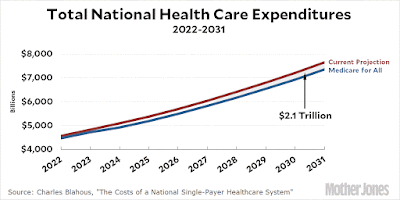
Now, as you might guess, this was not the spin the Mercatus folks put on their study. Their headline is “M4A Would Place Unprecedented Strain on the Federal Budget.” This isn’t really true, of course, since M4A would absorb all the costs of our current health care system but would also absorb all the payments we make to support it. That includes current taxes (for Medicare, Medicaid, and Obamacare), premiums paid by employers, premiums paid by individuals, and out-of-pocket costs from individuals. Instead of going straight to doctors, hospitals, and insurance companies, it would go instead to the federal government, which would then pay everyone else. It’s a lot of money, but it’s no particular “strain” on anything.
And overall we’d save at least $2 trillion over ten years. Blahous thinks the number would be be less because lots of people would flock to use free health care that they hadn’t used before, but most health economists disagree. Demand for health care would probably stay about the same, while costs would be more strongly contained because everything would be paid for out of tax dollars—and voters are strongly motivated to keep taxes low.
KEVIN DRUM
Here’s some good news. The libertarians at the Mercatus Center did a cost breakdown of Bernie Sanders’ Medicare for All plan and concluded that it would save $2 trillion during its first ten years:

Now, as you might guess, this was not the spin the Mercatus folks put on their study. Their headline is “M4A Would Place Unprecedented Strain on the Federal Budget.” This isn’t really true, of course, since M4A would absorb all the costs of our current health care system but would also absorb all the payments we make to support it. That includes current taxes (for Medicare, Medicaid, and Obamacare), premiums paid by employers, premiums paid by individuals, and out-of-pocket costs from individuals. Instead of going straight to doctors, hospitals, and insurance companies, it would go instead to the federal government, which would then pay everyone else. It’s a lot of money, but it’s no particular “strain” on anything.
And overall we’d save at least $2 trillion over ten years. Blahous thinks the number would be be less because lots of people would flock to use free health care that they hadn’t used before, but most health economists disagree. Demand for health care would probably stay about the same, while costs would be more strongly contained because everything would be paid for out of tax dollars—and voters are strongly motivated to keep taxes low.

Eating More Meat..
The Chinese Are Eating More Meat Than Ever Before and the Planet Can’t Keep Up
“In the end, per capita meat consumption in China is still half that of the United States.”
MARCELLO ROSSI
At the center of the table in a modest, high-rise apartment in the teeming city of Shenzhen, China, a simmering pot of soup stock was surrounded by large platters featuring mushrooms, different kinds of thinly shaved meat, lettuce, potato, cauliflower, eggs, and shrimp. Folding his hands together, Jian Zhang, a onetime rural farmer who now works as an employee for a small consulting firm in the city, asked his fellow diners to give thanks for the meal—the likes of which he could have only dreamed of when growing up in a remote village in the Jiangxi province.
The reason was simple: His family was so poor that they had to make do with barely sufficient food supplies. “I often went hungry when I was a kid,” said Zhang, his voice betraying the painful memories of a hard childhood. Until the late 1980s, when the state-imposed food rationing system was phased out from people’s daily lives, food supplies were in serious shortage across China. Coupons for buying basic foodstuffs like grain, flour, rice, oil, and eggs were issued based on monthly rations.
Meat, recalled Zhang as he dipped a piece of beef into the bubbly broth, was a rare luxury that his family could afford “two or three times a month.”
Things have changed remarkably since then. In the past three decades, breakneck industrial development and economic growth have driven millions of Chinese from rural areas to cities, altering much about the Chinese way of life, especially in terms of their day-to-day eating habits —an evolution perhaps most pointedly crystallized in the average Chinese consumer’s access to meat. Once a rare luxury, it has now become a commonplace. “I still remember when beef was nicknamed the millionaire’s meat,” said Zhang, who reckoned that he spends around 600 yuan, or $88, each week on food, and half of that on meat. “Now I can eat it every day if I want.”
Fueled by rising incomes rather than urbanization, meat consumption in China grew sevenfold over the last three decades and a half. In the early 1980s, when the population was still under one billion, the average Chinese person ate around 30 pounds of meat per year. Today, with an additional 380 million people, it’s nearly 140 pounds. On the whole, the country consumes 28 percent of the world’s meat—twice as much as the United States. And the figure is only set to increase.
But as the Chinese appetite for meat expands, the booming nation is faced with a quandary: How to satisfy the surging demand for meat without undermining the country’s commitment to curbing greenhouse gas emissions and combating global warming—goals that have been expressly incorporated into national economic, social development, and long-term planning under the Xi Jinping administration.
Raising animals for human consumption, after all, generates climate-changing emissions at every stage of production. For one thing, it requires vast amounts of land, water, and food to raise livestock. For another, cattle are themselves a source of huge quantities of methane, a greenhouse gas much more potent than carbon dioxide. Finally, cattle-raising is a major contributor to deforestation, another cause of increases in carbon emissions. Overall, emissions from the livestock industry account for 14.5 percent of total carbon emissions, according to the United Nations Food and Agriculture Organization, and these emissions are likely to increase in the near future as the production of meat is predicted to nearly double in the next 30 years.
With the world’s largest population and a rising craving for meat, China will be one of the biggest sources of increased demand. Experts at the advocacy group WildAid say that average annual meat consumption in China is on track to increase by another 60 pounds by 2030.
“One could argue that Chinese just want to enjoy the kind of life Westerners have for years. In the end, per capita meat consumption in China is still half that of the United States,” said Pan Genxing, director of the Institute of Resources, Environment, and Ecosystem of Agriculture at Nanjing Agricultural University. But, he added, “given the sheer population size, even small increases in individual meat intake will lead to outsized climate and environmental consequences worldwide.”
China is already the world’s largest emitter of carbon emissions, accounting for 27 percent of global carbon emissions. Its livestock industry is responsible for producing half the world’s pork, one-fourth of the world’s poultry and 10 percent of the world’s beef. No one knows exactly how much livestock contributes to the country’s mammoth carbon emissions. The last time Beijing produced official figures in 2005, it said that the national livestock sector accounted for more than half of the emissions from its overall agricultural activities. But one thing is for sure: how China will deal with soaring demand for meat is of paramount importance to both the nation and the rest of the world.
A 2014 study published in Nature by researchers at the University of Cambridge and the University of Aberdeen stated that to keep up with the demand for meat, agricultural emissions worldwide will likely need to increase by up to 80 percent by 2050—a figure that alone could jeopardize the ambitious plan to keep planetary warming below the 2-degrees Celsius benchmark set under the Paris climate accord.
China would contribute significantly to that growth. Marco Springmann, a sustainability researcher at Oxford Martin School at the University of Oxford, said that if meat consumption in the Asian country keeps growing as predicted, the nation would produce “an additional gigaton of carbon dioxide equivalents in greenhouse gas emissions, more than the current emissions of the global aviation industry” alone, and an increase of about one-tenth above China’s current level of emissions. According to a WildAid report, China alone could account for a growth in greenhouse gas emissions from 1.2 gigatons in 2015 to 1.8 gigatons by 2030.
“These calculations do not include land-use change,” Richard Waite, an associate at the World Resources Institute’s Food Program, told me by telephone from Washington, “but since meat production—especially beef production—takes up a significant amount of land, growing demand for meat in China would make for more forests converted to agriculture or pasture and also increase pressure on forests elsewhere.”
More meat on tables means more land given over to growing livestock feed—especially soybean, a crucial ingredient used to fatten up hogs and cattle quickly. Agricultural land, however, is in short supply in China. With around 20 percent of the world’s population, the country has only 7 percent of the world’s arable land, which is barely enough to keep up with the government’s goal of being self-sufficient for strategic commodities such as rice, corn, and wheat—a goal that has been at the heart of the national food security agenda for decades. Moreover, farmland in the country has been shrinking since the 1970s due to urbanization.
The increasing mismatch between available resources and surging demand has pushed China abroad in search of grain to feed livestock. The country now imports more than 100 million tons of soybeans per year, a figure corresponding to more than 60 percent of the global trade. In countries like Brazil, Argentina, and Paraguay, this has led to the clearing away of vast swaths of forests to make way for huge soybean monocultures, further driving up greenhouse gas emissions since forests typically store carbon in living biomasses, soil, dead wood, and litter, while plants sequester vast quantities of carbon dioxide from the atmosphere during photosynthesis.
Importing grains to feed livestock at home isn’t the only strategy China is adopting to bridge the gap. Under the auspices of the government, Chinese companies have been taking over foreign ones like Smithfield Foods, the world’s largest producer of pork. Meanwhile, the Chinese have also been importing meat from Australia, Brazil, Uruguay, Russia, and other countries, making China the world’s single largest market for meat.
“For decades, developed nations have relocated their factories to China, outsourcing their climate pollution and emissions,” said Waite. “Now China seems to have adopted the same paradigm.”
Sure enough, mitigating emissions from one the world’s largest, and most fragmented, livestock industries isn’t an easy task. It also doesn’t seem to be a priority for Beijing. “Some measures like subsidizing livestock farmers to turn animal waste—a major source of methane and nitrous oxide, two greenhouse gases much more potent than carbon dioxide—into organic fertilizers, encouraging them to take advantage of international carbon trading, or providing financial aid to install biogas plants to produce clean energy from manure have been implemented,” said Genxing of Nanjing Agricultural University. “But no specific low-carbon animal production policies exist in the country today.”
“For now, all the efforts are directed toward cutting emissions from sectors such as power generation and transportation,” he added, “and in the absence of major change, livestock emissions will continue to increase in China in the future.”
Programs aimed at curbing consumer demand for meat have begun to circulate. Two years ago, the Chinese Nutrition Society issued new dietary guidelines, which recommend cutting meat consumption in half, for example. The government also teamed up with WildAid to run celebrity-driven, high-impact media campaigns to promote the benefits of eating less meat. Should these campaigns prove effective, food-related emissions in China could be reduced by a billion metric tons compared to projected levels in 2050, Springmann suggested.
But accomplishing that is no easy feat. While the growth rate of animal protein consumption in the country has slowed somewhat in the past few years due to a number of factors—including new public health measures, better alternatives, contaminated meat, and a slowing economy—there are substantial cultural challenges that make it difficult to stem the tide. According Steve Blake, WildAid’s acting chief in China, most Chinese consumers fail to appreciate the link between higher meat intake to global warming. “While the issue of climate change is accepted in China much more so than in the U.S., the awareness about the impact of diet on climate change is very low,” he said. For a country where older generations “still vividly remember not even being able to afford meat a few decades ago,” he said, “meals featuring high amounts of meat are seen as a very good thing.”
Mixed messages from the government are also a hindrance.
“As is typical with Chinese governmental policy, the right and left hand are fighting against each other,” said Jeremy Haft, author of Unmade in China: The Hidden Truth about China’s Economic Miracle, in an email message. For example, Haft said, as the government encourages people to eat less meat, it is at the same time shifting the adverse environmental effects of cattle-rearing to the United States and other countries, where China continues to invest in agriculture.
But Haft pointed out that China has a rare opportunity to counteract the effects of this surge in meat-eating. “China’s remarkable development is regarded by many developing countries to be a model for lifting their own population out of poverty,” he noted. Given its centralized system, it has already proved it can be nimble in response to environmental risks — as happened with the transition away from fossil fuels toward renewable energy, which has caused national carbon dioxide emissions to decline or stay flat in the last few years, or with its subsidies for electrical vehicles, which has caused sales to skyrocket.
Now, Haft said, China needs to mount a similar effort to reduce meat consumption.
“If the country wants to become the world’s undisputed leading green superpower, it has to pave the way for a sustainable, low-carbon development [path] for low- and middle-income countries, inspiring them to follow suit,” Haft said. “And reducing emissions from the livestock sector should be part of the path.”
Subscribe to:
Posts (Atom)