A place were I can write...

My simple blog of pictures of travel, friends, activities and the Universe we live in as we go slowly around the Sun.


November 04, 2014

Bulldozing Democracy

Election 2014: Deep-Pocket Dark Money Bulldozing Democracy

'The 2014 midterms may well mark the election cycle in which the small donor got left behind,' analyst predicts

by Deirdre Fulton

In the final days of the midterm campaign, shadowy outside groups that wield heavy influence but don't disclose their donors are spending tens of millions of dollars on attack ads, mailers, and negative automated telephone calls aimed at tipping the balance in tight races across the nation.

Overall ad spending has broken $1 billion in federal elections and state governors’ races, according to the Center for Responsive Politics (CRP), which also predicted last week that the 2014 election cycle will cost at least $3.67 billion—slightly more than the 2010 election, which tallied $3.63 billion. In the same analysis, CRP noted that "[t]he 2014 midterms may well mark the election cycle in which the small donor got left behind," and that outside money has played an "outsized role" in this year's campaigns.

"As the post-Citizens United campaign finance system matures, we’re seeing evidence that the traditional campaign apparatus has been overtaken by shadow counterparts," said Sheila Krumholz, executive director of the Center for Responsive Politics. "These unaccountable actors give lie to the notion that they are independent of the candidates, and the negative nature of their participation will likely further suppress turnout that is already expected to be low."

This backs up findings released Monday by the Brennan Center for Justice, which documented record spending in 11 key U.S. Senate races, dominated by record-breaking outside spending, 58 percent of it spent by so-called dark money groups that do not have to disclose their donors. Such groups have spent at least $200 million nationally this election cycle, much of it in places with close races like North Carolina, which boasts the largest dollar amount of dark money as of October 29: $36 million.

According to CRP: "Overall, 38 percent of the ads bought by outside interest groups were bought by 'dark money' organizations that do not disclose their donors to the voters they seek to influence. In the heated battle for control of the Senate, nearly half—48.6 percent—of the ads were bought by such groups, most of them conservative. In fact, 48 percent of pro-Republican interest group ads in 2014 came from dark money groups, compared to 23 percent of pro-Democratic groups’ ads."

What's more, as the New York Times revealed on Sunday, "[m]uch of the advertising is being timed to ensure that no voter will know who is paying for it until after the election on Tuesday."
The Times reported:
Some of the groups are "super PACs" that did not exist before Labor Day but have since spent heavily on political advertising, adding to the volatility of close Senate and House races. 
Others formed earlier in the year but remained dormant until recently, reporting few or no contributions in recent filings with the Federal Election Commission, only to unleash six- and seven-figure advertising campaigns as Election Day draws near. Yet more spending is coming from nonprofit organizations with bland names that have popped up in recent weeks but appear to have no life beyond being a conduit for the ads. 
The groups’ last-minute fusillade of attacks helped push outside spending in races around the country to an average of at least $20 million a day last week. Total spending on Senate races reached $200 million in October alone, significantly more than in the same period before the 2010 midterms. 
...The onslaught shows how fast and aggressive strategists and donors in both parties have become about using the array of tools now available for pouring a lot of late cash into races. The efforts are a byproduct of court rulings like Citizens United and lax enforcement by the election commission and the Internal Revenue Service.
It's not only in congressional and gubernatorial races that groups are dropping major cash. The Brennan Center and the non-profit Justice at Stake revealed last week that with less than a week until Election Day, special interest groups had dramatically increased TV ad spending to influence state Supreme Court races in Illinois, Michigan, Montana, North Carolina, and Ohio. Outside groups have spent nearly $2.1 million on TV ad buys in these states for the November general election, the groups' analysis showed, with nearly $1 million spent over the last week.

"Special interest groups have realized that it doesn’t take much money to reshape an entire state court compared to high-cost elections for statewide political offices," said Brennan Center attorney Alicia Bannon. "At the same time, judges are forced to keep pace with deep-pocketed out of state groups instead of ruling on cases. It’s a lose-lose for judges and voters alike."

With Tuesday's elections on track to be the most expensive midterms in history, it's worth considering the magnitude of money spent and how it could be put to different use, investigative correspondent Chris Frates wrote for CNN on Monday.

"Four billion bucks is a boatload of cash," Frates said, rounding up CRP's estimate of $3.67 billion. "It's 10 times more than the government has committed to fighting Ebola in West Africa and would be enough to build 100 treatment centers and run them for years. That kind of money could also buy 25 F-18 fighter jets, pay for more than 12,000 students' K-12 education and have enough left over to produce a summer blockbuster."

At the Huffington Post on Monday, the Brennan Center's Lawrence Norden and Wendy Weiser note how recent U.S. Supreme Court decisions have changed the Election Day landscape to favor monied interests: "When the Court dismantled our laws regulating money in politics and gutted core voting rights protections, we knew those decisions would have consequences," they write. "But only now are we seeing the full scope of their impact: a return to pre-Watergate, pre-Civil Rights era practices. Cash from unknown sources is flooding the most important races, while state politicians have instituted new barriers to the ballot box for millions of Americans. Regardless of who wins, the integrity of our elections has been undermined."

John Oliver

John Oliver Takes on ALEC

by Michael Winship

War on Want

A Bold New Drive to Recast the War on Want

by Sam Pizzigati

So what do we do about inequality?

They got it, You don't...

Infuriating Facts About Our Disappearing Middle-Class Wealth

by Paul Buchheit

Huge waste of money....

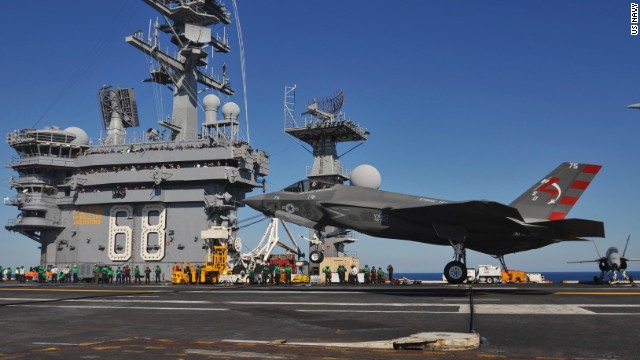
Navy's newest fighter makes first carrier landing

By Brad Lendon

A combination of old and new hooked up off the coast of San Diego Monday to give the U.S. Navy a glimpse into its future.

The moment was the first arrested landing aboard an aircraft carrier for the military's new Joint Strike Fighter, the F-35C Lightning II. An arrested landing means the jet was brought to a stop using a tailhook grabbing a wire stretched across the carrier's deck. The wire is attached to a gear system that brings the plane to a stop.

U.S. military\'s fighter fleet"This will be one landing out of thousands more that will happen over the next few decades," Lt. Gen. Chris Bogdan, executive officer of the Pentagon's F-35 program, said in a statement. Monday's landing came aboard the aircraft carrier USS Nimitz, the oldest active carrier in the Navy's fleet.

"I'm very excited to see America's newest aircraft on the flight deck of her oldest aircraft carrier," said Navy Cmdr. Tony Wilson, the test pilot who landed the F-35C aboard the Nimitz.

Tests of the F-35C aboard the carrier will continue for a few weeks, the Navy said. It is expected to be operational in the Navy's carrier air fleet in 2018, joining F/A-18E/F Super Hornets, EA-18G Growler electronic attack aircraft, E-2D Hawkeye control aircraft, MH-60R/S helicopters and Carrier Onboard Delivery logistics aircraft, according to a Navy statement.

The F-35C is just one version of the aircraft that the Pentagon has developed for use by the Marines and Air Force as well.

The F-35B, the Marine Corps version, is equipped with short take-off and vertical landing capability and began testing aboard the amphibious assault ship USS Wasp in 2011.

The F-35 was developed at a cost of nearly $400 billion so far and beset for years by cost overruns and delays. The plane's primary contractor, Lockheed Martin, puts the cost of each F-35C -- the most expensive of the three versions -- at $116 million, not including the engine. The company says on its website that the price has dropped 55% since the initial planes were contracted.

Engine manufacturer Pratt & Whitney said last month it has been awarded a contract worth just over $1 billion for a batch of 48 engines for the F-35.

The Pentagon ultimately wants more than 2,400 of the fighter jets, while hundreds more are expected over time to go to allies such as South Korea, Japan and Australia. More than 100 planes have been built so far, most for testing, but the program is still in its development and training phases.

The jets were temporarily grounded earlier this year following a fire on the runway at Eglin Air Force Base in Florida. No one was hurt. The military says the stealth fighter will be "the most affordable, lethal, supportable and survivable aircraft ever to be used" by so many services worldwide.

November 03, 2014

Someone sure got screwed....

One Day in an Elevator With Obama, Then Out of a Job

Halfhearted

A halfhearted U.S. war effort in the Middle East


common thread connects U.S. military operations of the last 20 or more years: We've persistently tried to fight them on the cheap. In gauging the requirements of a prospective campaign, “What do we need to win?” has repeatedly taken a back seat to “What's the minimum we can get by with?”
The Pentagon calls the result Operation Inherent Resolve. A more accurate name would be Operation Halfhearted Effort.-

The ongoing air campaign against Islamic State illustrates the point. Having declared that this new threat must be destroyed, the Obama administration refuses to provide the forces needed to do just that. Hence, Washington's unseemly scramble to recruit proxies willing and able to do what the United States won't do: put “boots on the ground.” The Pentagon calls the result Operation Inherent Resolve. A more accurate name would be Operation Halfhearted Effort.

When marketing a new product or running for political office, cheapness seldom offers a recipe for success. In war, that truism applies in spades. There, the urge to economize invites greater long-term costs without anything remotely resembling victory at the far end.

From 2002 to 2003, American generals thought invading Iraq would require half a million troops or so. Then-Secretary of Defense Donald H. Rumsfeld knew — or claimed to know — better and allocated only 148,000. Sufficient to get to Baghdad, that number proved woefully inadequate to control the country. The George W. Bush administration had expected Operation Iraqi Freedom to yield a quick, tidy win. Instead, the Iraq war became the second-longest and just about the most expensive in U.S. history.

The longest is the ongoing conflict in Afghanistan, never adequately resourced by Bush or his successor. U.S. troops provided to pacify a country slightly larger than Texas and with a present-day population of 30 million reached a peak just above 100,000. Sure, North Atlantic Treaty Organization allies pitched in, but never in sufficient numbers to make a difference. So 13 years after arriving in Afghanistan, U.S. troops are now withdrawing, not victoriously, but with fingers crossed that the place won't fall apart. We've seen what a similar hope in Iraq produced.

These campaigns, and others, are part of a broader enterprise that from the outset suffered from this problem of under-resourcing. Over the course of several decades, U.S. forces have invaded, occupied, bombed and raided places throughout the greater Middle East. We have killed considerable numbers of people. We have overthrown governments and installed others in their place. We have put the hurt on some very nasty militant groups (only to see others almost immediately appear).

What larger goal these actions are meant to achieve is not entirely clear. Proffered explanations have ranged from securing the world's oil supply to eliminating terrorism to spreading the blessings of freedom and democracy.

Regardless of actual purpose, the overall undertaking qualifies as hugely ambitious. Through its military exertions in the Islamic world, the United States is clearly trying to achieve something very big. And whatever that something might be, it seems plain that the job is nowhere near to being finished. If nothing else, the rise of Islamic State affirms that “Mission Accomplished” is still nowhere in sight.

Yet from the outset, Americans have refused to acknowledge what employing military means to do big things entails. On this point, the lessons of history are quite clear. Business as usual won't do. Put simply, doing big things militarily necessitates reconfiguring national priorities, with peacetime pursuits taking a back seat to wartime imperatives.

The old-fashioned word for this is mobilization, which implies changing just about everything: tax rates, patterns of consumption, social relationships, educational priorities, the prerogatives exercised by the state and, of course, the size of the armed forces. In simplest terms, mobilization implies collective effort that involves collective sacrifice, without which wars fought to achieve big things are doomed to fail.

Vaguely inclined to “support the troops” as long as they themselves remain personally unaffected and uninvolved, Americans willfully ignore this essential truth: If you will the end, you must will the means. Meanwhile, in Washington, where dereliction of duty is a way of life, no one in a position of influence has mustered the gumption to state the obvious: For the United States to achieve “victory” in the greater Middle East will require exertions that exceed those made thus far by orders of magnitude.

Is victory, however defined, worth a vastly greater expenditure of lives and treasure? If the answer is yes, then it's time to let out the stops. If the answer is no, then continuing on our present course is foolish, immoral and constitutes a betrayal of those sent to fight a war that we have no hope of actually winning. If we're not willing to go all in, then we should go home.

Mountaintop Removal

Mountaintop Removal Coal Mining Industry Continues to Poison Appalachia


There has been some shocking news out of Appalachia in recent days. First, a game-changing new study demonstrated, for the first time, a direct link between the dust from mountaintop removal coal mines and lung cancer. Then Ken Ward, Jr. of the Charleston Gazette reported on a West Virginia lab worker who pled guilty to falsifying water test results because of pressure from the coal industry.

And on top of all that came another report, this time out of Kentucky, showing that mountaintop removal is straining the ecosystems needed to support wildlife and critical stream habitats.

The results of the West Virginia University health study are jaw-dropping. Researchers exposed human lung tissue to mountaintop removal dust in the lab, and they found the dust exposure promoted development of lung cancer is the first study that has demonstrated such a direct link between mountaintop removal pollution and these serious health consequences.

I think someday we’ll look back on the publication of this study as a watershed moment in the long mountaintop removal struggle. Health problems have been long documented in mountaintop removal country, including in dozens of peer reviewed studies, but the coal industry has always tried to shift the blame to other causes. As Dr. Michael Hendryx told the Charleston Gazette:

“The larger implication is that we have evidence of environmental conditions in mining communities that promote human lung cancer. Previous studies … have been criticized for being only correlational studies of illness in mining communities, and with this study we have solid evidence that mining dust collected from residential communities causes cancerous human lung cell changes.”

Meanwhile, the plot thickens in the case of the lab that diluted, substituted and otherwise tampered with water samples from coal mining sites across the state. These self-reported water samples are a key part of oversight of coal mining pollution. Just yesterday came further news from West Virginia that despite the state Department of Environmental Protection revoking certification for the lab where the falsified tests happened, the state board of environmental quality issued a stay on the revocation pending a full hearing to be held in December.

My colleague Bill Price, a fellow West Virginian and long-time advocate for Appalachian communities, is as baffled as I am. “The decision to not immediately implement the certificate revocation shows a total disregard for the safety of local residents,” he said. “If you can’t do it right, you don’t deserve to be a certified water testing company. Period.”

Bill, like me and so many others, hopes that federal and state investigators will dig much deeper, and faster. We have a right to know if the coal industry is pressuring other labs to falsify water tests, and guilty parties should be held responsible.

Meanwhile, the study out of Kentucky shows that reclamation of mined sites does not lead to recovery of the ecosystem, and that’s because of fundamental, long term damage to waterways caused by surface and mountaintop removal mining activities. You can’t blow off the top of the mountain, shove all the debris into a nearby valley, then replant some trees and expect everything to go back to normal. Among other reasons, this is because the science is making it increasingly clear that coal mining waste continues to pollute streams decades after mining ends.

As residents in West Virginia, Kentucky and other Appalachian states call for an end to mountaintop removal and all the harms it causes, they are also calling on their leaders to chart a safe, healthy, prosperous path forward for the region. In West Virginia and Kentucky, legislators have assembled task forces to begin tackling the question of how to diversify coalfield economies—the SCORE program in West Virginia and the SOAR project in Kentucky. It remains to be seen whether these efforts will really grapple with moving beyond a boom and bust fossil fuel economy, but it’s a start. Meanwhile, grassroots organizations in both states are doing sophisticated, important work on economic transition.

As Appalachia charts its future, one thing is clear—it’s long past time to end mountaintop removal. The U.S. EPA can act to rein in the worst abuses of the coal industry. Congress can pass the Appalachian Communities Health Emergency (ACHE) Act and the Clean Water Protection Act. There is no time to waste—with each passing day, lives hang in the balance.

Global Warming? Still here..

U.N. Panel Issues Its Starkest Warning Yet on Global Warming

Suppress the Black Vote in North Carolina. It's Not Working.

Republicans Tried to Suppress the Black Vote in North Carolina. It's Not Working.

Thousands more African-Americans have already turned out to vote this year than in 2010. Here's how Democrats are doing it.


By Erika Eichelberger

"The first question I ask my customers is: Are you registered?" Jolanda Smith says.

Smith runs a hair salon on the outskirts of Fayetteville, North Carolina. Her hair is dyed lavender and her arms are covered in heart and shooting-star tattoos. In the lead-up to the midterms, she's lending her storefront to Democratic Sen. Kay Hagan's reelection campaign. Smith passes out sample ballots and flyers and tells customers how to register and where their polling location is. Last Saturday morning, she was talking God and voting as she straightened a customer's hair.

"It's: Are you gonna vote, yes or no?" she says, sectioning off a lock and pulling it through the iron. "God gave us a choice, and the choices are always yes or no. It's not maybe. It's not, 'Let me think about it,' 'cause those are excuses…On down from choosing Christ to voting. You gonna vote? Yes or no?"

IN 2013, North Carolina Republicans, led by Hagan's opponent, state house speaker Thom Tillis, passed a far-reaching voting law that curtails early voting and eliminates same-day registration. The Justice Department sued North Carolina over the law, charging it was discriminatory and would depress minority turnout.

Hagan's campaign knows that black voter turnout could decide her fate—and, by extension, determine which party controls the Senate for the final two years of President Barack Obama's term. If African-Americans manage to turn out at presidential-year levels—if they're at least 21 percent of the electorate—Hagan will probably win, says Tom Jensen, director of the North Carolina-based polling firm Public Policy Polling.

That's why the Hagan campaign, and its coordinated get-out-the-vote organization Forward North Carolina—along with the NAACP, state Democrats, and get-out-the-vote outfits—launched unprecedented efforts this year to mobilize black voters.

Those efforts are paying off. On the first day of early voting last week, 76-year-old Ruben Betts was sitting on the curb in a shopping center parking lot wearing an "I just voted" sticker on his sweater. The president reminded him to vote this year, he says: "Obama sent me a letter." As of Thursday, 24 percent of early voters in North Carolina were African-American, according to records from the state board of elections. That's up from just 17 percent at the same point during the last midterm elections in 2010.

The Hagan field operation, which has 40 offices, 100 staffers, and 10,000 volunteers, is the largest that North Carolina has ever seen in a Senate race. By comparison, the get-out-the-vote campaign for North Carolina Secretary of State Elaine Marshall's failed Senate bid in 2010 was almost entirely run by volunteers. "We had no money, I mean no money," says Thomas Mills, a Democratic political consultant who helped coordinate Marshall's field operation. "And maybe five paid staffers. The difference in what they've got now—it's just not even same thing. There's no comparison."

Democrats have spent $1 million on ads aired on black radio stations. The Democratic Senatorial Campaign Committee partnered with the Congressional Black Caucus this month to send black lawmakers on a bus tour through North Carolina and five other battleground states. And Hagan's campaign is collaborating extensively with black clergy across the state and roughly 150 black small business owners like Smith who are helping turn out voters this year.

Smith says the main issue that convinces her customers to go to the polls is health insurance. (North Carolina didn't expand Medicaid, so about 500,000 poor North Carolinians are still without insurance.) Jobs top the list, too. Smith's shop sits on Murchison Road, one of the main drags leading out of Fayetteville. The further you drive from the town center, the less money there is—the storefronts become more faded, the sidewalks get weedier, the landscape grayer. "It's hard to get a job even if you have a degree," she says.

Smith adds that anger over the August shooting of Michael Brown in Ferguson, Missouri, will also bring people in her community out on Tuesday. "It was more than just him," she notes, referring to the police brutality she witnesses regularly in her community. "You have some in the system that say, 'I'm gonna hide behind this badge and use it for injustice instead of justice'…To us it feels like it's racist."